
Most SEO teams talk about “AI visibility” as a single space. New data on 3.7 million mentions in ChatGPT, Perplexity and Google AI Overviews show that this is not the case. And the gap between the three AI systems is wider (and strategically more important) than your dashboard probably recognizes.

In today’s article, we will consider in detail:
- Why does the average AEO indicator hide the only important result?
- What types of pages and domains are really moving between AI systems.
- The transition from measuring presence in AI to measuring portability.
One of the biggest differences between AEO and SEO is that AEO runs on more platforms.
Omnia data shows, based on multiple samples, that only 2.35%-2.45% of the quoted URLs appeared in ChatGPT, Perplexity, and Google AI Overviews for the same query. 91% of mentions appeared in only one AI system.
Visibility in AI is not a single issue. In fact, these are three different distribution systems that sometimes overlap, but usually don’t.
- Only 2% of URLs are quoted by three AI systems simultaneously
- The overlap rate of 2% is maintained throughout all selection stages
- Commercial queries also do not give unambiguous results
- Manuals are 2 times higher than the main pages
- Visibility is not the same as portability
- What does this mean for SEO specialists
- Methodology
- Dataset size and time interval
- How the prompta were selected
- AI Coverage study
- Classification methodology
Only 2% of URLs are cited by three AI systems at the same time
Most people would assume that if a URL is cited by one major AI system, it has a reasonable chance of appearing in others.
But a sample of 20,000 queries shows that only 2.37% of the quoted URLs are displayed in all three AI systems for the same query.
Meanwhile, 91.07% are displayed in only one. These two numbers should be side by side because they explain each other. The remaining ~7% overlap in pairs, which means that AI systems use mostly disparate pools rather than ranking the same pool differently.
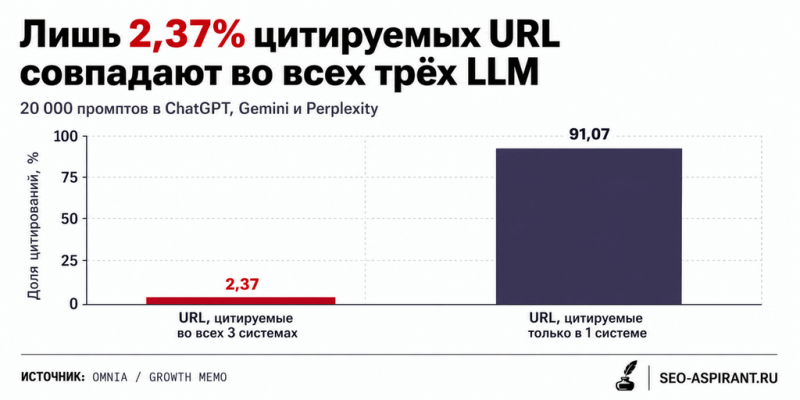
For AEO/SEO teams, this means that a single consolidated visibility metric is the wrong unit of measurement. The average AEO figures hide this.
A brand can look strong in the aggregate, but be invisible in 2 out of 3 AI systems. SEO teams aiming for a single average AI visibility indicator combine three ranking systems into one indicator and call it a strategy.
The overlap rate of 2% is maintained throughout all selection stages
The overlap rate of about 2% and the exclusivity rate of about 91% remain virtually unchanged over the four samples.
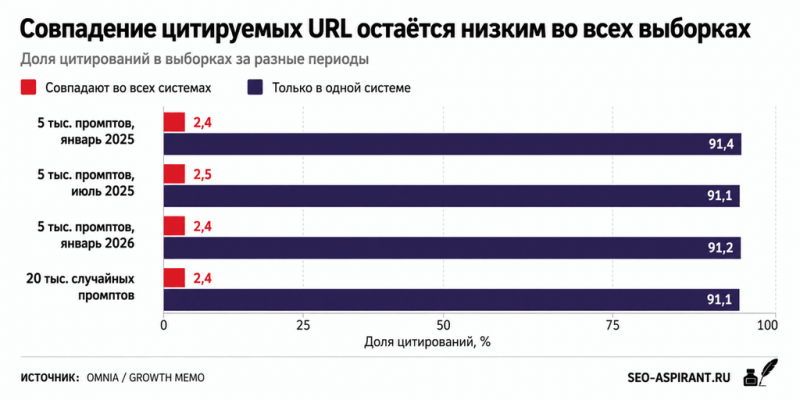
This consistency is more important than the exact decimal point. The gap in consensus is not the result of a single set of requests or a single time window. It looks structural.
In the third quarter of 2025, the overall overlap was 2.2%. In the fourth quarter of 2025 and the first quarter of 2026, it increased to 2.7%. The share of citations exclusive to AI systems decreased from 90.1% to about 88%. So yes, there is a slight convergence. But even after this shift, fragmentation still dominates.
Commercial queries also don’t give unambiguous results
Separating by intent is one of the most subtle but useful parts of a dataset. It can be argued that commercial requests should generate greater agreement. When someone is looking for “the best CRM system,” “the best sneakers,” or “the best project management software,” the range of acceptable sources seems narrower than when using broad information requests.
Surprisingly, the data does not confirm a significant difference.
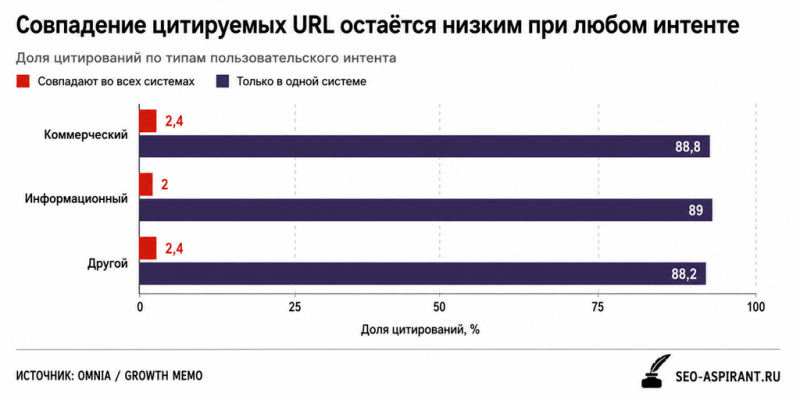
Commercial queries show 2.4% of the total match. Information requests show 2%. Even when a request should narrow down the set of responses, AI systems in most cases still choose different sources.
This is contrary to popular belief in SEO and content strategy. SEO teams often assume that queries with a high degree of intent will match the overall authority. In fact, everything looks much better. Even in the commercial segment, the main work is done by each AI engine’s own search logic, which sources it trusts, and which formats it prefers.
The manuals are 2 times larger than the main pages
The breakdown by page type below shows that guides and tutorials have the greatest overlap between AI engines – 2.3%, followed by blogs — 1.8%, category pages — 1.6%, product pages — 1.2% and main pages — 1.1%.
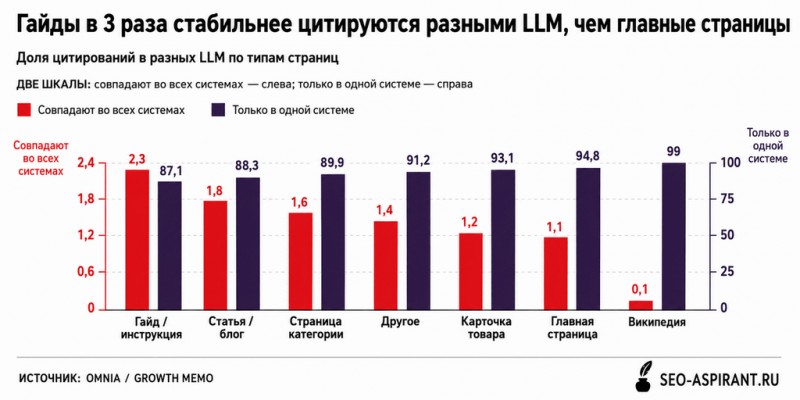
Two outputs:
- Firstly, explanatory content is distributed better than branded or transactional materials. If you want to achieve the best results in AI systems, the best candidate is not the home page or the product page. This is a page that helps, explains, compares, or teaches, but keep in mind that AI can respond directly to such content formats.
- Secondly, even the best types of pages show poor results in absolute terms. Management does not benefit from AI systems in any meaningful way. The right approach here is not to “publish more guides and you will win everywhere.” It’s simpler: useful content is distributed better than branded content.
Visibility is not the same as portability
One of the most common mistakes in this field is to confuse the frequency of citations with the portability of citations. Wikipedia is the most obvious example. It occurs 16,073 times in the dataset, but only 1.3% of these occurrences are universal for all AI systems.
Reddit occurs 14,267 times, but only 0.1% are universal. The Reuters agency appears 1,202 times, and the worldwide match rate is 0%.
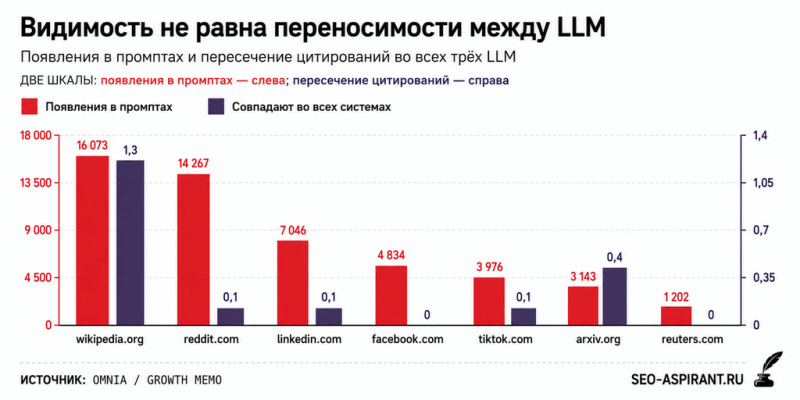
That’s why mobility is an important indicator. The domain can be displayed on all platforms, but hardly move, which means that the brand dominating the dashboard summary may be one step away from invisibility due to the peculiarities of one platform. Presence shows how visible you are. Mobility shows how stable this visibility is.
What does this mean for SEO specialists
Stop treating visibility in AI as a single thing. Examine the comprehensive visibility of your domain by measuring:
- Presence is the percentage of tracked requests where your domain is displayed in any AI system. Presence indicates whether you are visible.
- Portability is the percentage of quoted URLs that appear in all three (or more) AI systems. Portability shows how stable this visibility is.
- Concentration is the percentage of citations coming from a single AI system. Concentration shows which AI system your current dashboard is “secretly” built on.
If the intersection between AI systems is so low, a single AEO strategy is too abstract to be useful.
When you and I approach AI visibility from a holistic perspective, it forces us to ask clearer questions.:
- Which AI system is most important to us?
- Which of our resources move between AI systems, and which work only in one?
- Are we measuring presence when we should be measuring portability?
It also changes the brand teams’ approach to diagnosis. A weak home page in all AI systems may not be a problem for the home page itself. This is a symptom of something broader: AI prefers usefulness over brand centricity. In this world, visibility is achieved not so much by being an official source as by being a useful source.
Here you and I have to ask ourselves: “How do we create resources that will be in demand by various AI?”. This is a narrower question. And it’s better than, “How do we take a leading position in the AI niche?”
Methodology
There are several caveats to this analysis:
- The data set is shifted towards the Omnia customer base.
- The separation by intent and type of pages is based on classification using regular expressions, which is useful for directional analysis, but is not an ideal taxonomy.
These caveats do not significantly weaken the main conclusion. The most important signal is not accuracy at the edges, but consistency in the center. No matter how the boundaries change, the same pattern repeats: very little overlap, very high specificity for AI, and only minor differences in time, intent, or page type.
The size of the dataset and the time interval
The analysis is based on four query samples. Three cohorts of 5,000 requests each, tracked from January 1, 2025; July 1, 2025; and January 1, 2026. A separate random sample of 20,000 queries confirms the main indicators of 2.37% and 91.07%.
The time interval covers the period from the 3rd quarter of 2025 to the 1st quarter of 2026. (as of today) and includes a total of 3.7 million links to URLs. The division into commercial/informational/other purposes is taken from approximately 2.6 million URLs in the combined sample. The page type division covers 4.1 million URL appearances.
How the prompta were selected
20,000 prompta were randomly selected from a pool monitored by Omnia in real time. The pool reflects what the real marketing teams decided to track, taking into account the geographical reach of Omnia’s customers (mainly Spain, as well as the United Kingdom, the Nordic countries and other EU markets).
Each product is displayed in the primary language of its country, so Spanish is represented in greater numbers compared to the US-only dataset.
Industry composition: fintech, insurance, tourism, SaaS, B2B services. Consider the results obtained as benchmarks for the European AI search.
AI Coverage Study
The study covers three AI systems: ChatGPT, Perplexity and Google AI Overviews. Each of them simultaneously sends the same request for one minute, twice a day, with localization by country, and each system is requested in its standard web mode without authentication.
Perplexity is tracked using Sonar, while ChatGPT and Google AI Overviews use each vendor’s standard production model for web browsing without authentication (neither OpenAI nor Google specify a specific version).
Classification methodology
The intent and type of the page are determined using regular expressions. Categories of intentions: Commercial, Informational, and Others. Categories of page types: Guide/Tutorial, Article/Blog, Category Page, Product Page, Homepage, Wikipedia, and Others.
The rules are based on keywords and URL patterns, which makes them fast enough for a dataset containing millions of URLs, but rough on the boundaries. Extreme cases belong to the “Other” category, so this category occupies a significant share in both intent tables and page type tables. Consider regular expression abbreviations as directed rather than authoritative.