When ranking websites, Google and Bing take into account brand mentions and citations, along with backlinks. Therefore, today we will talk about how to optimize the brand-link ratio to improve visibility in the 2026 organic search.

We all know that backlinks are important for SEO. But as search engines become more intelligent, it is important to consider other factors of external search engine optimization. Textual brand mentions and contextual references to objects such as company employees, products, and locations are becoming increasingly important in the age of entities.
These metrics are used by Google and Bing to assess trust and visibility. They are also crucial for improving visibility on AI platforms such as ChatGPT, Gemini, and CoPilot.
In this guide, we’ll talk about the brand—link ratio- when you think about how much time, effort, and money to invest in developing your brand versus how much to invest in building a mass of links.
- Sunset of the reference era
- Changing Google’s attitude towards backlinks
- Brand visibility and trust
- The ratio of brand and links
- Moving from the link graph to the entity graph
- Entities and E-E-A-T
- What is a “mention” in this case?
- Quoting, joint mention, joint appearance and joint link
- Brand mentions as modern signals of authority
- Brand mentions and traditional SEO
- Brand mentions and AI SEO
- Determining the brand-link ratio
- Factors to consider
- Which ratio is considered optimal?
- Sites with high and low brand-to-link ratios
- Measuring brand presence on the Internet
- Brand visibility assessment methodology
- Strategic implications for SEO specialists and marketers
- Preparing for the era of visibility in AI
- From backlinks to overall brand value
Sunset of the reference era
Getting backlinks with the “dofollow” attribute has been and remains a key element of SEO.
However, the focus has shifted over time. Our understanding of Google’s algorithms has improved, and the algorithms themselves have evolved to combat spam. Today we are more interested in the quality of links, not the quantity. And we understand that links with the “nofollow” attribute should be part of an SEO strategy if you want to avoid penalties.
But isn’t it time to stop considering backlinks as the main source of brand authority?Back in 2014, Moz founder and search industry veteran Rand Fishkin suggested that brand mentions on the Internet are viewed by Google as “implied links.” However, he was referring to a patent, so this may not have been the case in practice at the time.
Now it looks like brand mentions can have a real impact on positions. Links are still needed, but it’s time to include mentions without active links in your strategy.
Changing Google’s attitude towards backlinks
In the late 90s, when Google first appeared on the market, backlinks were at the heart of the search engine. Their PageRank formula measured the number and quality of links (to a certain extent) and was the main factor in determining site positions.
However, over the years, Google has reduced the importance of links several times. In a 2014 video, Matt Cutts, who was the head of the anti-spam team at the time, stated:
“Over time, backlinks will become a little less important.”
As Google’s algorithms have become more complex, they have started to take into account other measures of quality and trust.
Google employees Gary Illis, John Mueller, and Duy Nguyen have made similar statements in recent years. Illis said that links were not among the top three ranking factors in 2023, and the 2024 spam policy update removed a line regarding the importance of links:
“Google uses links as one of the factors determining the relevance of web pages.”
Were these comments made in order to discourage people from using links to manipulate rankings? Maybe. But Google has repeatedly stated its intention to reduce the importance of backlinks, and it is logical to assume that the company will continue to move in this direction.
Brand visibility and trust
What other signals does Google use, along with backlinks? Two important ones are brand awareness and trust in the entity.
In a recent LinkedIn post, Jeremy Moser, CEO of uSERP, emphasized this point:
“Both Google and Bing appreciate the mentions brand + citations in addition to backlinks.
Google uses them as reinforcement for link authority, and Bing can sometimes display them instead of links when on-page and entity signals are strong.”
However, it’s not just the mentions themselves that are important. Google uses natural language processing (NLP), machine learning systems that can understand human language, semantic relationships, content themes, and moods.
Numerous mentions of your brand on the Internet are good, but it is also important where you are mentioned and in what context. This is what contributes to the trust of search engines and the understanding of your brand as an entity.
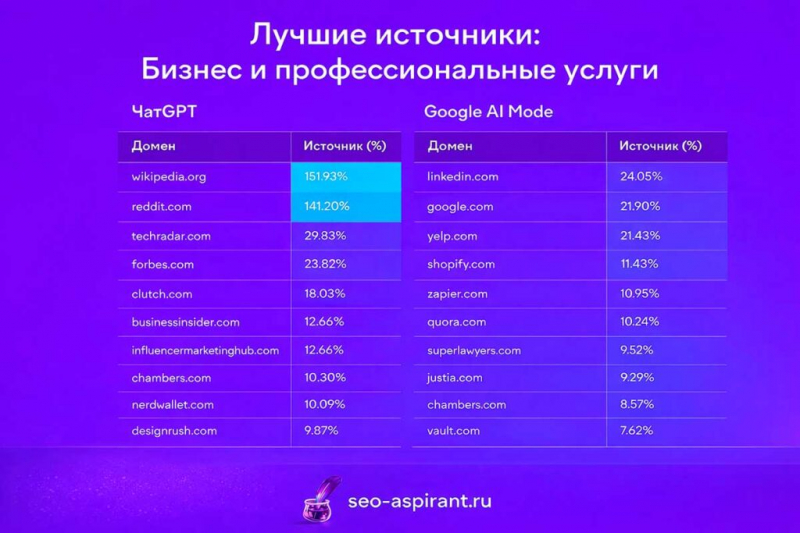
Generative artificial intelligence platforms such as ChatGPT are also paying attention to such signals. Since ChatGPT prefers to use Wikipedia and Reddit as sources, it’s easy to assume that mentions on these platforms also carry more weight. On the other hand, Google AI Mode uses a wider range of platforms.
Let’s say you’ve created a new website about business news. You don’t have many links yet, but you’re starting to be mentioned in the same context as reputable publications like Forbes, The Economist, and The Wall Street Journal. These mentions give your site legitimacy and credibility, and can also be used by search engines and artificial intelligence as a ranking signal.
Thus, creating your brand as a separate entity not only increases its visibility to users browsing the web, which leads to an increase in the number of clicks and conversions for your brand, but also improves its visibility in search engines and on AI platforms.
The ratio of brand and links
If search engines and AI platforms take into account not only links, but also brand awareness and trust, then it makes no sense to measure only link-related indicators such as credibility and the number of referring domains.
Instead, it’s time to start including other indicators. What they will be depends on the specific business, but one of them may be the ratio of brand and links. By analyzing the ratio of brand mentions and backlinks, you can strive for the right balance to maximize SEO results.
For example, let’s go back to our fictional news site. This site probably has a high brand to link ratio, as it has managed to get a lot of brand mentions and media coverage, each of which is not necessarily accompanied by a link.
What a successful relationship looks like will largely depend on your brand, your industry, and your goals.
Transition from the link graph to the entity graph
Search engines have evolved. Now they don’t just count links — they display the relationships between entities.
But what exactly does this mean?
The network of links between websites is one way to understand their interrelationships and relative importance. Google has a map of all these links — it’s called the “link graph”. But the link graph is not the only way to understand brands.
I have already mentioned entities in this guide — they are crucial for establishing a strong relationship between a brand and links. Entities are all nouns related to your business: your employees, your products, related concepts in your industry, and so on. These entities also have relationships; multiple sites mentioning your entities are an alternative signal of authority and trust that search engines consider valuable.
These relationships between entities are part of a huge database that Google calls the “Knowledge Graph.” But more generally, you and I can call them the “entity graph”.
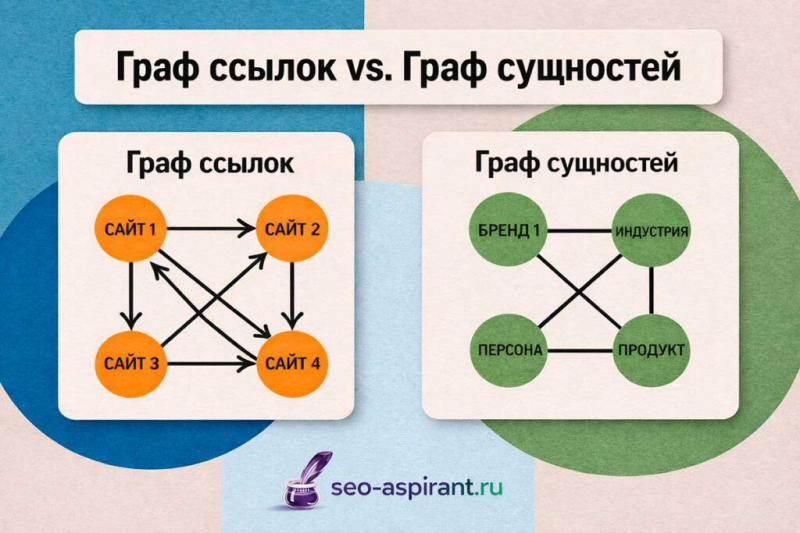
Over time, the importance of the entity graph has increased as search engines use AI to better understand language and semantic relationships. At the same time, the importance of the link graph has decreased as search engines have found other ways to identify the most relevant results.
If we add to this the fact that generative AI platforms also evaluate brands as entities, their importance increases dramatically, especially given that AI has become part of Google’s regular search queries in the form of AI responses.
Entities and E-E-A-T
People can be entities, and these entities are related to Google’s emphasis on expertise, experience, credibility, and reliability— E-E-A-T. Why? Because it is the people in the business who have this expertise, not the company itself.
Your blogs should list the authors, and the “About Us” page should list real people. But these people should also be included as entities, along with mentions of your brand elsewhere on the internet.
Adding a quote from the relevant person to your press releases, along with their position and qualifications, is an easy way to create a valuable identity for your brand.
What is a “mention” in this case?
When it comes to terms like “mentions” and “citations,” the advent of generative AI has slightly changed their meaning.
The word “mention” in the context of SEO used to refer exclusively to the Internet — usually without an attached link. It was a mention of your brand on a website other than your own, such as a mention of your business news outlet on the Forbes website.
But now the definition has become a little broader.
Mentions or brand mentions: when your brand name appears on a third-party resource (for example, on a website, in AI search results, on social networks).
When people say “mentions,” they usually mean cases where there is no accompanying link, but it doesn’t really matter if there is a link or not.
If you want to be more specific, you can use terms such as:
- Mentions on the Internet: mentions on third-party websites.
- Mentions in AI: mentions in the results of generative AI.
- Mentions without links: mentions not accompanied by a hyperlink.
The word “quotes” itself is also a bit ambiguous these days. Ideally, you and I should be more specific:
Structured quotes or local SEO quotes: A type of online mention that includes a brand name, address, and/or phone number (NAP). Structured quotes use a standardized format that is easily understood by search engines, and they are useful for local SEO. For example, a listing on Trip Advisor that lists the address will allow Google to determine if the “London Hotel” is actually located in London.
AI quotes (also known as sources or quotes from sources): when the brand name or website domain is indicated after a piece of information in the generative AI response, showing where the information came from. For example, if you ask Perplexity if Sean Bean always dies in movies, he will answer that some of the information in the answer is taken from Maximonline.
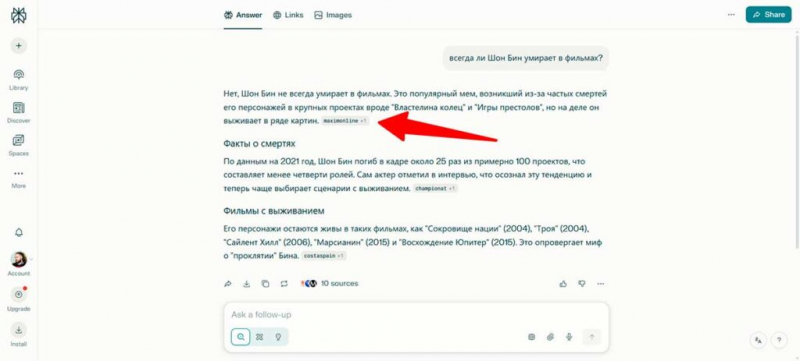
Mentions and backlinks from the Web and social media can affect traditional SEO, but they also have a huge impact on the likelihood of your brand appearing in AI responses. In fact, increasing brand awareness on the Internet demonstrates its credibility and reliability. This, in turn, leads to greater visibility in SERPs and AI responses.
Quoting, mentioning together, appearing together, and linking together
This topic is also a minefield of words starting with “co-“:
Quoting
Social media is when two websites, brands, or organizations are mentioned together by a third party, suggesting a connection between them. “Citation” here has a more general meaning referring to the source, as this term originates from the world of academic papers.
Social media can help Google understand that two brands are part of the same industry. For example, when Reddit users compare Ben and Jerry’s and Hagen-Dazs, search engines and AI platforms may realize that these are the two most popular ice cream brands in the world.
Joint mention
Similar to “co-quoting” but a bit more general, co-mentioning simply means that two entities are mentioned on the same page, in the same paragraph or sentence, often without direct comparison or reference.
For example, if a user has posted a list of their favorite ice cream flavors in Threads, Ben and Jerry’s and Hagen-Dazs may be mentioned, but they are not quoted or compared directly.
Joint appearance (usage)
Sharing is when words and phrases appear together in the content of one or more pages. In this way, Google can learn to associate your brand with certain phrases or themes.
For example, Ben and Jerry’s can be associated with things like “ice cream,” “quality,” “taste,” “sustainability,” or “activism.”
Coreference (joint reference) or semantic coreference
Coreference or semantic coreference is when search engines can understand from the context of a page that two or more different terms refer to the same object.
For example, in an article about Ben and Jerry’s, “brand”, “ice cream maker” and “company” can mean the same thing.
None of these terms with the prefix “co-” implies the presence of a backlink, although it can be!
Simply put, they are related to the ability of search engines and artificial intelligence to understand language and the relationship between objects and words, thanks to smart systems based on machine learning.
It is important not only how often you are mentioned, but also where and in whose company. Together, they improve overall SEO by shaping the understanding of your brand as an entity.
If you are frequently mentioned along with other popular brands and in content that is thematically relevant and contains the right keywords, you are more likely to appear in relevant results.
Brand mentions as modern signals of authority
Let’s look at the importance of brand mentions from the perspective of both traditional and AI SEO.
Brand mentions and traditional SEO
Although Google does not explicitly state that it uses brand mentions on the Web and social media as an SEO signal, it hints at this.
For example, Illis said the following at the Brighton SEO conference in 2017:
“If you publish high-quality content that is frequently quoted on the Internet “and I’m not just talking about links, but also mentions on social media, and what people say about your brand, then you’re doing everything right.”
Google has patents related to the so-called “context assessment”, which analyzes the relevance and naturalness of the content surrounding the link. Logically, this can also be applied to brand mentions by analyzing the words and phrases that appear next to the brand name in the text.
Bing is much more transparent. In 2016, Dwayne Forrester said the following on SMX West:
“A few years ago Bing understood the context and tone of the statements, as well as that how to link mentions without a link. As the volume increases and the credibility of these mentions increases, you will get a boost in ranking.”
Comparing these official statements with what you and I know for sure about the technologies used by these companies, we can draw some conclusions about which factors are important for SEO.:
- number of mentions;
- the mood (sentiment) underlying the mentions (i.e. positive or negative);
- which sites have mentions and are whether they are reliable in themselves;
- joint mentions with other organizations or brands (if two brands or organizations appear more often or closer to each other, they may be assigned a higher “joint mention weight”, which may be a stronger signal for SEO);
- joint mention of the brand with relevant keywords and topics;
- inclusion of entities such as employee names and product names;
- E-E-A-T in relation to the brand and its employees.
Regardless of the current situation, mentions on the Web and social media are likely to have an increasing impact on traditional SEO over time, especially as artificial intelligence becomes more integrated into search.
Brand mentions and AI SEO
The data here is very specific: brand awareness and mentions on websites and social media have a big impact on AI visibility.
By “visibility into AI” I mean mentioning and quoting sources in AI-generated responses on platforms such as Google AI Overviews, ChatGPT, and Perplexity.
Nick Hagler’s research shows that the more often a brand is searched for online (based on monthly search volume, or MSV), the higher its visibility in AI.
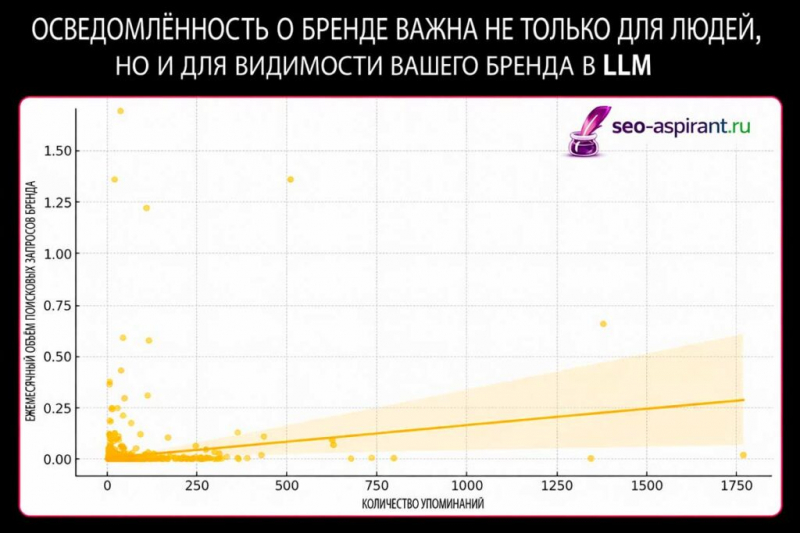
Brand mentions on the Internet show a similar correlation. You and I also know that Google’s artificial intelligence responses analyze content related to brand mentions, as there is another patent related to context assessment.
There is also less direct information that also points to a correlation between brand mentions and AI SEO effectiveness. The Semrush AI Visibility Index report notes that some AI platforms prefer to quote certain websites. For example, as I mentioned above, ChatGPT prefers Reddit and Wikipedia.
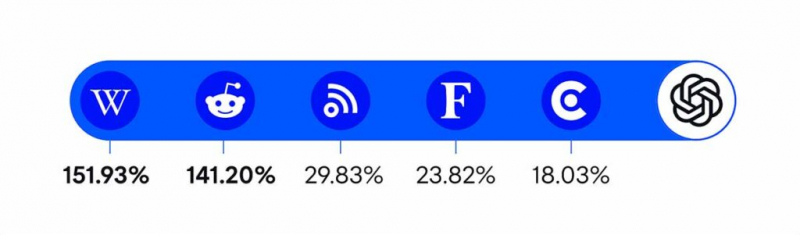
This does not necessarily mean that ChatGPT attaches more importance to mentions on these sites, but it would not be surprising if this turned out to be true. A more frequent mention on these platforms certainly wouldn’t hurt.
Example: Semrush recently increased the recognition share of its AI from 13% to 32%. How? Through a combination of measures such as identifying targeted queries, optimizing existing content, adding new content, and increasing brand awareness on platforms such as Reddit and Quora.
Defining the brand-to-links ratio
In simple terms: the brand-to-links ratio is equal to brand mentions + citations -links.
Let’s say your site has 900 mentions, 100 citations, and 600 links. This is a ratio of 1000:600, which can also be expressed as 5:3.
However, 5:3 is a bit inconvenient for comparison and difficult to calculate.
Therefore, I suggest simply dividing brand mentions and citations by the number of references — this is a slightly different way of mathematically expressing the ratio. In this case, we get a result of 1.67.
When using the division method, a number greater than 1 means that you have more brand mentions than links. This is the expected result, since it can be assumed that some mentions will not be accompanied by links, and most links will include a mention.
Factors to consider
Previously, I would just talk about citation on the Internet (remember, there was even such a “Citation Index”?). A low coefficient would be better, because you and I were only interested in links. They were the main factor influencing search engine visibility. The mentions on the internet were just interesting additional information.
Now we are more interested in mentions on the Web and social networks than before. They affect visibility in AI, and can even be used as a proxy for visibility in all SEO channels. Therefore, a higher coefficient may be useful for you.
In addition, you will need to consider several other factors. For example, mentions and citations in AI are relevant now. Should they be included in the formula?
You may decide not to include them, because mentions and citations in AI are one of the things you would like to influence in order to increase the share of mentions on the Internet and social networks. AI tools do not analyze their own responses to make decisions about which brands and organizations to display.
In addition, you should decide whether to use raw numbers of mentions and backlinks, or the number of pages with links and mentions. If there are five links to your site on one page, does it count as 5 or 1?
Your choice may depend on the data you have. Consistency is important. If you include the raw numbers of mentions and citations in one part of the equation, you should include the raw numbers of backlinks in the other part.
Which ratio is considered optimal?
The optimal ratio for your site depends on a number of factors:
- The industry in which you work. In competitive niches, backlinks are more important, so the ratio may be lower. Websites of the YMYL category can serve as a good example. On the other hand, a skin care brand with a real TikTok review that has gone viral may have many more mentions than links, resulting in a higher ratio.
- Your goals for traditional SEO and AI SEO. If the key goals are brand awareness or visibility in AI, the ratio may be higher. If traditional SEO is more important, it may be lower.
- How developed is your brand. New sites and lesser-known brands may focus on backlinks first, as links have a direct impact on traditional SEO, as opposed to mentions (at least for now).
- Your domain’s authority (and comparison with competitors). If you already have a high reputation from backlinks, and it is more than that of competitors, you can afford to put more effort into getting mentions and developing your brand.
Although it is difficult to determine exactly which ratio is ideal, it should be greater than 1. Why? Because lower numbers indicate unnatural link building schemes. This would mean that you have a lot of links where your brand or domain is not mentioned in the text, and this could be a spam signal for Google.
On the other hand, if your score is too high, you potentially lose the backlinks you could have received through outreach. Or perhaps you’re paying too much attention to branding, ignoring the need to generate backlinks.
Sites with high and low brand-to-link ratios
What might sites with high and low brand-to-link ratios look like?
Sites with a high score have high visibility and few links. They appear in real discussions on social networks and other platforms and, most likely, appear more often in AI responses.
They may also have higher click-through rates and conversions, due to increased brand awareness.
Retail brands that are very popular on social media, such as clothing and cosmetics, can fall into this category. It’s safe to assume that most people who mention Nike in any form on the internet are not referring to a corporate website.
On the other hand, sites with a low index have a lot of links, but are weak in terms of brand. This can work well in competitive industries where the credibility of backlinks is still paramount. However, as a result, they probably miss out on the opportunity to increase AI visibility and brand awareness.
B2B brands such as SaaS companies often fit this model. For example, online mentions of Basecamp are more often product reviews or step-by-step instructions, rather than random mentions of consumers.
Measuring a brand’s online presence
So, how do you determine your brand’s visibility in practice? There are a number of indicators and tools that can help with this.
- Organic brand search. Google Analytics, Yandex Metrika, Yandex Webmaster, Google Search Console can give you an idea of how frequently users search for your brand and related terms, as well as how much traffic your website receives requests from the brand.
- Entity trackers. Tools such as Yext use named entity recognition technology, which allows you to create your own entity graph for your brand.
- Tools for monitoring social networks and brand. These tools monitor social media, media, and websites to find mentions and discussions about your brand. Although different tools have slightly different capabilities here, some, such as Sprinklr, also include sentiment analysis.
- Tools for assessing visibility in AI. Tools like Semrush’s AI Visibility Overview evaluate how often you appear in generative search results.
By combining data from these various sources, you can calculate your site’s overall brand visibility index. It measures the visibility of your brand in relation to your target audience across multiple channels (for example, organic search, social media, artificial intelligence search, brand mentions on the internet).
These days, brand search goes far beyond Google or Yandex organic search, so a more holistic approach will help you evaluate performance much more effectively and identify gaps.
Brand Visibility Assessment Methodology
To determine your brand’s visibility, it is useful to conduct a series of audits of your backlinks, entities, as well as your visibility in AI and on the Internet.
Tools such as Semrush’s Backlink Audit or Ahrefs are ideal for auditing backlinks. They allow you to check the quality of links, reject low-quality links, and access common link metrics.
You can also use the Google Search Console to find out the number of backlinks or pages linking to your site, which can be useful for calculatingbrand and link ratios. However, link auditing is more of a manual process here.
Entity Audit is a useful tool for semantic SEO that helps search engines understand words, their meanings, and the relationships between them. Entities are a key part of semantic SEO because they are words that Google and Yandex need to understand clearly.
An audit can begin by simply viewing your website (or only the key pages if it is very large) to mark the entities found there — your brand name, employee names, products, locations, etc.
Find the most important ones in organic. Does relevant information appear? Or is there another brand with the same name that occupies the knowledge bar on the right side of Google or Yandex search results?
If you find any problems or shortcomings, think about how to adjust the content to better represent the relevant objects. Also check the markup.
For example, if the search engine in the search results shows information about some other person, instead of your key employee, create a new simple website about him. This will be the main reliable source of information.
You can also ask ChatGPT to suggest SEO entities based on your brand, competitor, or relevant keyword, and see if they are on your site or in third-party content about your brand.
Finally, audit your brand’s visibility on various platforms using social media monitoring tools and AI Visibility Overview.
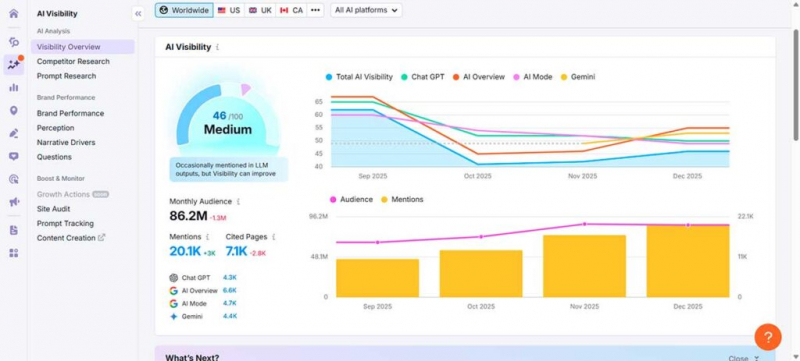
This tool provides key indicators of AI visibility, including mentions, source citations, and monthly audience. It also gives you an idea of exactly what content has triggered these mentions, which is incredibly useful for determining which part of your content and promotion strategy is working.
Even more important, perhaps, are the requests to AI in which your brand was “missed”. This gap analysis is great for finding opportunities where better content or more relevant mentions on the Web and social media can help you appear in similar AI queries in the future.
Your visibility in AI also indirectly indicates how strong your brand is online — the strength of your brand, as an entity on these platforms, is one of the key ranking factors for AI SEO.
In general, it’s useful to explore various tools and metrics and figure out what’s right for your business. Obviously, organic traffic and website positions are no longer sufficient metrics for many brands. Regardless of whether you’re calculating the brand-link ratio or using a different metric, a broader view of brand visibility will be helpful.
Strategic implications for SEO specialists and marketers
Why should you even think about it?
Because times are changing. You or your organization may already be engaged in some kind of PR activity, promoting ideas, or syndicating content. You may even have used these actions to build links. But now all this can indirectly affect positions, even if there are no links.
If you’re completely focused on link building and your entire budget is focused on it, now is a good time to take a step back and assess the situation. For example, do you prioritize traditional SEO over AI visibility?
Regardless of whether your mentions-to-links ratio is low or high, this is an indicator that you can compare with what you think might be ideal for your business. Then compare this to how the budget is allocated between link building and brand strengthening activities. Does the budget ratio match the metric you want to achieve? If not, isn’t it time to reallocate part of the budget?
Consider switching from prioritizing DR (focusing solely on links from sites with high domain authority) to building brand credibility. This means reducing artificial and potentially spammy backlink building tactics and moving towards a more sustainable model of increasing brand awareness and reputation.
Every time your brand is mentioned on the internet, it should strengthen your credibility. This may mean implementing digital PR campaigns that focus less on links and more on engaging in conversations in places where your audience spends time online.
An excellent example here is IKEA’s “The Co-Worker” campaign. They created a Roblox game where players could work in an IKEA virtual store with furniture, meatballs, and sharks. The reaction was impressive! They have received over 2,000 media articles worldwide, with 16 billion views.

Preparing for the era of visibility in AI
Increasing the number of mentions of your brand online can have a significant impact on visibility on generative AI platforms. As a rule, a high ratio of mentions to links means better visibility in AI.
SEO specialists can no longer afford to focus only on indicators such as organic traffic and positions in organic search. It’s not that these things aren’t important. But the search environment is becoming more fragmented, and users are turning to AI, TikTok, and other platforms to find brands from which to buy something.
Visibility has become more important now, not only on Google, but also as a single metric across the Web, AI, and social media.
Focusing on metrics like brand to link ratio not only helps with AI visibility today, but it also prepares your SEO for a future in which backlinks may no longer matter. AI and traditional search are likely to become more and more intertwined, and search engines may shift from backlinks to weighing brand signals in their ranking models.
From backlinks to the overall brand value
Revolutions don’t happen overnight, but they seem to.
There is likely to be a turning point in the coming months. Those who are currently making efforts to develop the brand will be rewarded. And those who don’t can be left behind.
The ratio of mentions to links is not the opposite of link building. Links are still important and will probably remain so for some time to come. But now there is a clear shift in algorithms towards the brand.
A new guideline in SEO is the desire to become an entity. And being able to measure that is a key part of the equation. Indicators such as the ratio of mentions to links, AI visibility, and the brand visibility index can help in this.
And how to understand which indicators should be used? It depends on who you are communicating with about those very indicators.
Recommendation of the month: