
Research shows that using prompta from users “reliably” reduces the accuracy of certain types of tasks, but it works well in other categories.

Using “You are an expert” type promptings can both improve and degrade performance. A new study shows that hints like “You are an expert” improve compliance with a person’s expectations, but they can reduce the accuracy of facts in tasks that require large amounts of knowledge, while the effect varies depending on the type of task and model. That is, “You are an expert” type prompta work better in some types of tasks than in others.
- Expert promptings
- Behavioral signal management
- Advantages of using a character
- Disadvantages of using the character
- What the study showed in the end
- Main conclusions
Expert prompta
“You are an expert” type promptings are a common way of shaping the reaction of large language models, especially in applications where tone and compliance with human expectations are important. They are widely used because they improve the readability and perception of results. Given the prevalence of “You are an expert” type prompta, it may seem surprising that their actual impact on productivity remains unclear, as previous studies show contradictory results, calling into question the effectiveness or harmfulness of this method.
Immediately, the researchers came to the conclusion that the person selection initiatives bring neither widespread benefit nor harm, and that their effectiveness depends on the type of task.
It was discovered:
- They improve results related to consistency, such as tone, formatting, and behavior for security purposes.
- Person selection promptings impair productivity in tasks that require factual accuracy and logical thinking.
Based on this, the authors propose a method called PRISM (Persona Routing via Intent-based Self-Modeling), which selectively applies personas using intent-based routing, instead of treating personas as the default setting. Their results show that person selection promptings work best as a conditional tool and allow us to better understand when person selection promptings help and when they should be avoided.
Behavioral signal management
In the third section of the article, the researchers claim that expert personalities have “useful behavioral signals,” but naive use of expert personalities does as much harm as good. They say this raises the question of whether these benefits can be separated from the harms and applied only where they improve outcomes.
Behavioral cues influence LLM results. It is these signals that are the reason for the effectiveness of people’s promptings. They contribute to improving tone, structure, safe behavior, and how well responses meet expectations. Without them, there would be no benefit from the promptings of people.
However, the article shows that the same signals interfere with tasks that depend on actual accuracy and reasoning. That is why the article considers them as something that needs to be managed rather than maximized.
These signals include elements such as:
- Stylistic adaptation and tone matching: using a professional or creative style.
- Structured formatting: providing step-by-step or technical diagrams.
- Format compliance: helps the model follow complex structures such as professional emails or step-by-step explanations of STEM disciplines.
- Intent-based: Focusing the model on the user’s primary goal, especially in tasks such as data extraction.
- Security Opt-out: More effectively detecting and rejecting malicious requests by assuming the role of a “Security Monitor”.
Advantages of using a character
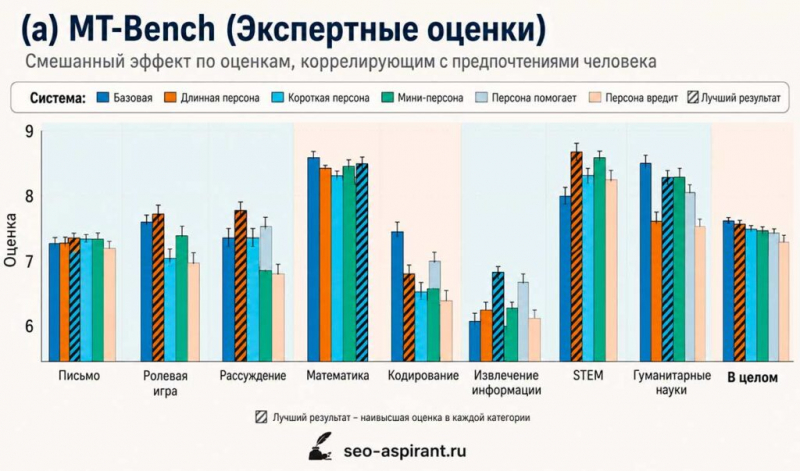
The study found that the use of character-based promptings proved effective in five of the eight task categories:
- Information extraction: an increase in scores by +0.65.
- STEM-Disciplines: increase in points by +0.60.
- Logical thinking: an increase in points by +0.40.
- Written work: improvement due to better stylistic adaptation.
- Role-playing as a domain expert: improvement by better matching the tone.
The use of character-based promptings has proven effective in the above categories, as they focus more on style and clarity than on the correctness of the answer in terms of facts and knowledge.
It was also found that the longer and more detailed the prompt based on the character’s image, the stronger the desire for consistency and security.
Disadvantages of using a character
On the contrary, an expert persona consistently worsened the results in the remaining three (out of eight) categories, since it relies on accurate fact extraction or strict logic rather than style and clarity. The reason for the decrease in performance is that adding a detailed expert persona essentially “distracts” the model by activating “instruction-following mode,” which prioritizes tone and style.
Expert personalities are activated by “memorizing facts.” The model is so focused on trying to behave like an expert that it forgets the information it received during the initial training. This explains the decrease in accuracy regarding facts and mathematical calculations.
Expert personality type testing showed the worst results in the following three categories:
- Mathematics
- Programming
- Humanities (memorized factual knowledge)
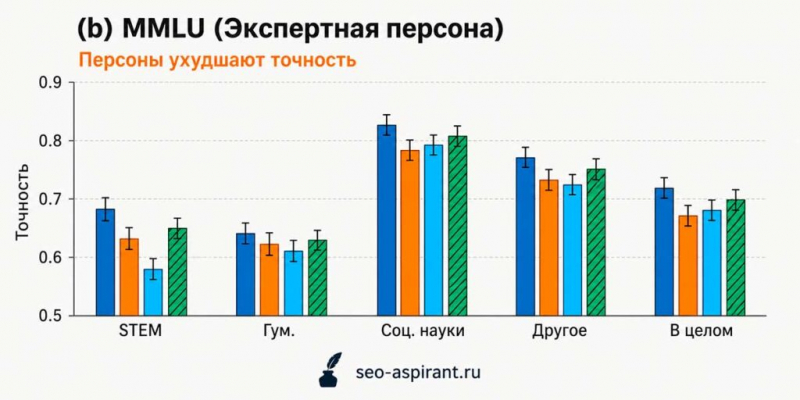
The article notes that on one of the knowledge tests (MMLU), the accuracy decreased from a baseline of 71.6% to 68.0%, even with a “minimal” personality type, and dropped even lower, to 66.3%, with a “long” personality type.
The researchers explained the security improvements:
“More detailed descriptions of persons provide more complete information about compliance, proportionally enhancing the behavior associated with configuring instructions.”
And showed why the accuracy of facts suffers:
“Persona worsens pre-training tasks.
During pre-training, language models acquire such capabilities as memorizing factual knowledge, classifying, recognizing connections between entities, and reasoning without prior training. These features can be accessed without the need to configure instructions and may be disrupted by additional context following instructions, such as expert promptings.”
As a result, the study showed
The researchers concluded that personal image-based promptings constantly improve the performance of tasks that depend on consistency, such as writing texts, role-playing games, and security behavior. At the same time, it worsens performance in tasks based on knowledge gained during pre-training, such as math, programming, and general knowledge tests.
They also found that a model’s sensitivity to characters depends on her level of training. The models that are best optimized to follow instructions are more “tuned” (or manageable), which means they get the most gains in safety and tone, but suffer more significant losses in factual accuracy.
Main conclusions
1. Selectively use promptings based on a personal image.:
- do not use default “You are an expert” type promptings;
- consider persona-based promptings as a situational approach (their widespread use is fraught with hidden risks inaccuracies).
2. Persona-based promptings are effective for:
- text quality;
- tone;
- formatting and organization;
- readability.
3. Tasks for which persona-based promptings are not useful, and instead neutral hints should be used to maintain accuracy:
- fact checking;
- statistics;
- technical explanations;
- logically complex results;
- research;
- SEO analysis.
4. Remember these three conclusions:
- use persona-based promptings to create content, and then switch to non-persona-based promptings (or stricter mode) to test facts;
- detailed promptings based on the image of an “expert” enhance tone and clarity, but reduce the accuracy of facts and knowledge;
- promptings like “You are an expert” can cause the model to prioritize sound correctness over actual correctness.
5. Select the prompta for the task:
- content creation: persona helps;
- analysis and verification: persona harms.
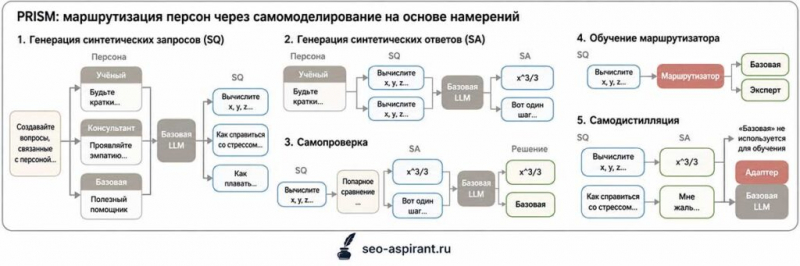
The most effective approach is not a single prompt, but a workflow in which the promptness varies depending on the task, similar to the PRISM approach. used by researchers.
Link to the study: arxiv.org .