
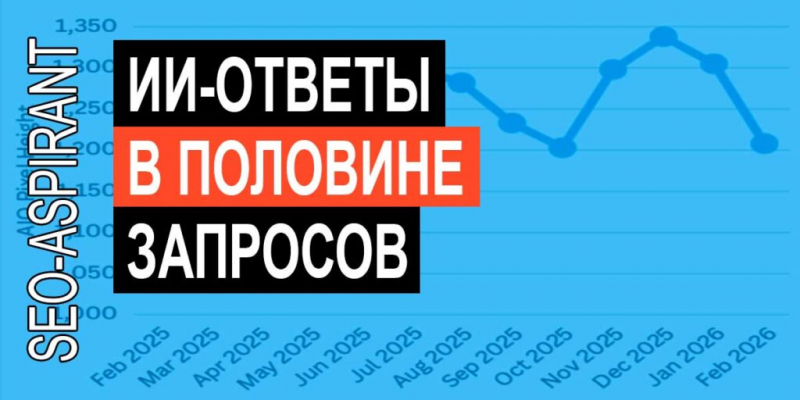
Google’s AI responses are expanding their presence in nine niches, while the tool itself dominates almost half of all search queries.
A new study from BrightEdge shows that although AI responses have expanded their reach since launch, they have not yet completely displaced traditional organic search results: just over half of queries still receive classic search results.

- AIOs grew by 52% in one year
- Classic organic search still prevails
- Search is a multifaceted process
- AI responses change the search experience
- AI responses do not reflect the ranking on the first page
- Growth continues along with continued reliance on organic search
AIOs grew by 52% in one year
A comparison over the twelve months from February 2025 to February 2026 shows that AI Overviews coverage has grown by an impressive 58%. The strongest growth in the number of queries that trigger AI search results is observed in the field of education: from 18% of queries in May 2025 to 83% of queries by December 2025.

Similarly, requests in the field of B2B technologies showed a significant increase: from 36% to 82%. Restaurants are another of the fastest growing industries in terms of the number of requests with AI results, ranging from 10% to 78% of requests.
Meanwhile, healthcare—related inquiries have significantly enriched AI results since 2024 – in 72% of cases. By December 2025, this figure had grown to 88%, which was a tremendous success for AI-powered search results. Given that AI is usually guided by user satisfaction metrics, this may mean that users appreciate the opportunity to receive explanations on medical topics in the conversational form of a chatbot.
These results coincide with a report published by OpenAI in January 2026, which stated that more than 5% of all chat conversations are related to healthcare, and 25% of active users worldwide use ChatGPT to search for health-related issues.

It’s not just patients who use AI. According to a recent Brookings Institution survey, 53% of medical professionals also use AI.
The nine industries with the most significant growth:
- Healthcare
- B2B technologies
- Education
- Insurance
- Entertainment
- Travel
- E-commerce
- Finance
- Restaurants
Classic organic search still prevails
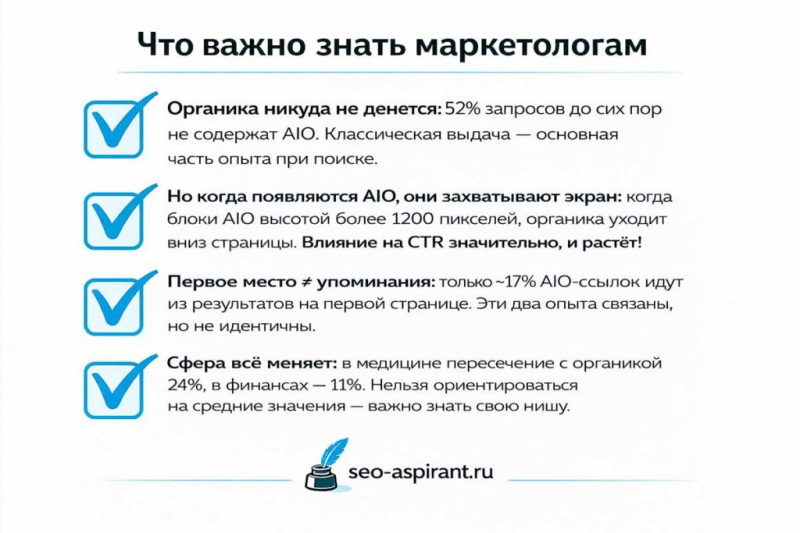
Despite the high growth rates of AI, classic search results still account for about 52% of all searches, which means that AI and classic search are almost equal in number. However, it is clear that many high-value queries in areas such as B2B are increasingly moving away from classical search and are more often appearing in AI results.
To some extent, this may not be so surprising, because technology is constantly changing, and there is always something new that seems to be better understood in conversational form, rather than through ten links, as, for example, in healthcare.
As for the growing interest in restaurants, what can explain this? Is this related to the “research” aspect? If so, this may indicate a content gap that reviewers or the restaurants themselves may be forced to fill.
However, just over half of the search queries still return a standard results page consisting entirely of ten blue links. AI responses are now being called in almost half of all tracked queries, but this has not led to the disappearance of the traditional search page (SERP).
Search is a multifaceted process
We can say that the search functions in two different modes, depending on the query. Some result pages start with an AI summary.Others show only ranked links. The conclusion here is unequivocal: AI responses are widespread, but the search remains divided, not completely transformed.
This division of search is part of a longer—standing trend that has been in place for over twenty years, since the introduction of Google Local Search, Google Maps, and product search. Since the early 2000s, the classic ten links have been perceived more as nostalgia than reality, but this has become really obvious to the SEO community with the introduction of Featured Snippets in 2014, which clearly showed that answers have become a priority for Google, and that ten links are now definitively a thing of the past.
The fact that AI and classic search share almost equally the keywords used by Google users is part of this ongoing trend of search constantly evolving towards more accurate answers.
AI responses change the search experience
AI responses do not appear on every request. But when they do appear, they radically change the structure of the search results page, which is hard to miss, since they often represent a large block of content placed above traditional lists.
The report shows that the average height of the AI response exceeds 1200 pixels. The standard desktop screen is about 900 pixels. The first organic result is completely outside the visible area (under the “threshold” of the screen).
AI responses can dominate visual perception, taking up more than the entire visible part of the screen, even before the user scrolls the page.
AI responses are not displayed with every query, but when they appear, they take up most of the screen and displace traditional search results lower on the page. The conclusion is this: users are becoming more accustomed to searching for information in a conversational form, and the search paradigm is shifting towards getting answers and discovering new things.
The AI responses do not reflect the ranking on the first page
The key difference lies in how AI responses select sources. Traditional search results are ranked by position. AI responses synthesize information and cite sources that often differ from the top organic results.
This is due to the Google FastSearch effect, a method of obtaining the top three organic results for multiple queries in response to a single conversational query that uses these results to generate a response.
A BrightEdge report reveals this phenomenon, showing that only about 17% of the sources cited in AI responses also rank in the top 10 organic results. The report explains this as follows:
“Ranking in the first place of organics does not guarantee automatic citation in AIO. And the lack of ranking on the first page also does not exclude the possibility of being quoted in AIO. These two experiences are related, but not completely the same.”
The AI response quotes are based on indexed content, but they do not reflect the search results on the first page. This brings us back to the concepts of FastSearch and Query-Fanout, where one long conversational query with multiple subtexts triggers a series of queries, each of which yields three organic results.
However, the overlap increases if we consider not only the top 10, but the top 100 search results. This broader binding expands over time. AI responses use content from the organic ecosystem, but cite materials that often differ from traditional organic search winners. This means that the visibility of AIO is related to organic indicators, but it is not equivalent to ranking on the first page.
All of this requires a more thorough analysis to understand what it means to create content and rank it well.
Growth continues along with continued reliance on organic search
The BrightEdge report shows that the development of AI responses is progressing rather than stabilizing. Their presence has increased by 58% compared to last year, and they now account for almost half of all tracked queries.
The overall overlap of citations in the top 100 results increased moderately, while the overlap in the top 10 remained almost unchanged.
These data do not indicate a binary transition from organic search to AI search, but they show continued growth. Traditional organic results still represent the majority of queries. But in the future, I would like to understand exactly which queries still trigger the classic search — can these be local or navigation queries?
AI responses are expanding in frequency of occurrence and visually dominating the interface where they are applied, and the classic search is now significantly reduced.