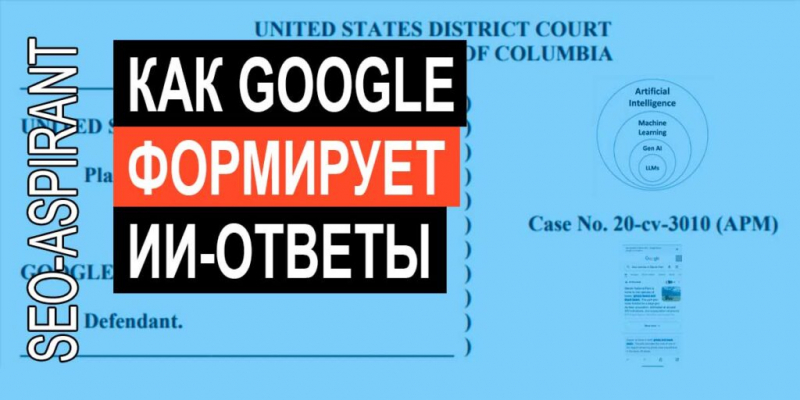
Court documents in the Google antitrust case revealed information about FastSearch, a proprietary system that few SEO experts have heard of.
It is at the heart of how Google forms its AI Reviews, prioritizing speed over the deeper analysis underlying traditional search results.
This difference raises an important question: what exactly does FastSearch prioritize?

- What is Google FastSearch?
- Compromise between speed and quality
- 1. Smaller pool of documents
- 2. Simplified ranking signals
- 3. Acceptable accuracy threshold
- RankEmbed: an important semantic signal
- Limited third-party access via Vertex AI
- What does all this mean for your content strategy?
- Don’t give up the basics of SEO
- What Can I start doing it right now?
- What does FastSearch tell SEO specialists about Google’s development direction?
What is Google FastSearch?
FastSearch is an internal Google technology used for Gemini models and AI response generation.
While traditional Google search analyzes huge amounts of data using hundreds of ranking signals, FastSearch uses a more focused approach.
The antitrust lawsuit provides the following explanation:
“Google uses a proprietary technology called FastSearch to base its Gemini models. FastSearch is based on RankEmbed signals, which are a set of search ranking signals that generate abbreviated, ranked web results that the model can use to create an informed response. FastSearch provides results faster than search because it extracts fewer documents, but the quality of the results is lower than that of fully ranked web search results.”
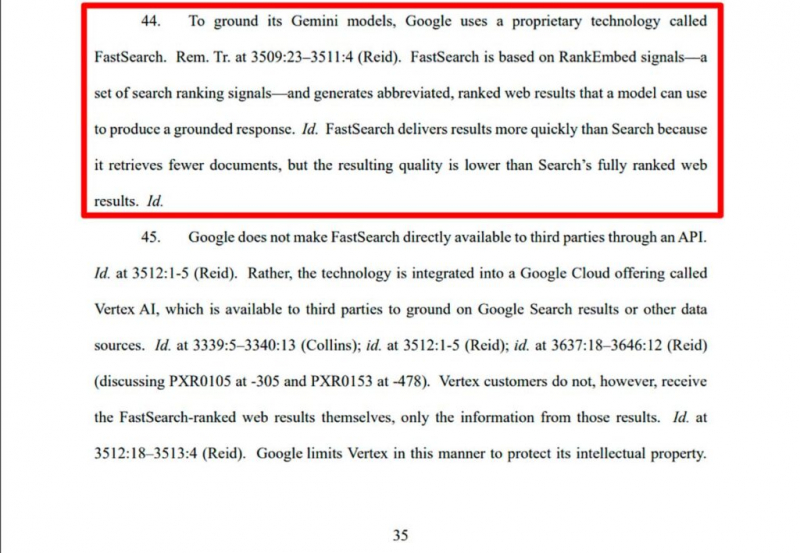
Marie Haines brought this to the attention of the industry after reviewing the judge’s decision in the Google monopoly case.
This “discovery” appeared on page 35, hidden in technical explanations about Google’s artificial intelligence infrastructure.
The trade-off between speed and quality
FastSearch makes three key compromises to achieve faster response times.
1. A smaller pool of documents
Instead of searching through the entire Google index, FastSearch extracts information from a targeted subset of pages. This significantly reduces processing time when Gemini needs a real basis for dialogue responses.
2. Simplified ranking signals
FastSearch mainly relies on RankEmbed signals rather than Google’s full ranking arsenal.
These signals focus on the semantic relationship between queries and content, rather than traditional authority metrics such as backlinks or domain reputation.
3. Acceptable accuracy threshold
Google acknowledged on page 35 of the court document that “the resulting quality is lower than that of fully ranked search results,” although the results remain “good enough to justify” AI responses.
This explains why questionable content sometimes appears in AI responses, as the optimized process prioritizes semantic comparison over comprehensive quality assessment.
RankEmbed: an important semantic signal
The document also describes RankEmbed as one of Google’s “superior” deep learning signals (on page 138), capable of “finding and exploiting patterns in vast datasets.”
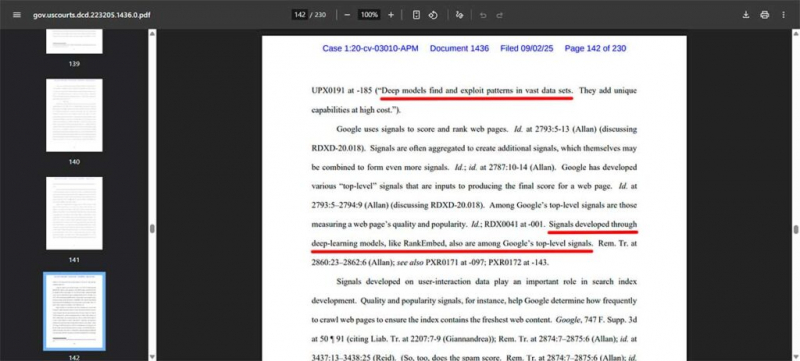
Unlike signals that measure popularity or count backlinks, RankEmbed asks a simpler question: how much does this content match what the user actually meant?
This semantic focus means that a page with few backlinks, but with crystal clear thematic relevance, cansurpass a domain with high authority, but with obscure or confusing content.
This shift has significant implications. The power of traditional SEO does not always automatically translate into visibility in AI Overview.
Limited third-party access via Vertex AI
Google does not offer FastSearch as a separate API. Instead, the technology is integrated into Google Cloud’s Vertex AI, which allows companies to create their own AI applications.
The documents state:
“However, Vertex customers do not receive the web search results themselves, ranked by FastSearch, but only information from these results. Google restricts Vertex in a way that protects its intellectual property.”
This means that you cannot directly test FastSearch results in the same way that Google analyzes traditional search results. The system remains a “black box”, the visibility of which is limited by what is displayed in AI responses.
What does all this mean for your content strategy?
FastSearch architecture identifies four strategic priorities for visibility in AI:
- Write clearly. If RankEmbed prioritizes semantic relationships, the content must immediately and accurately meet the user’s intentions. Don’t bury your main idea in three paragraphs.
- Create thematic depth. FastSearch’s semantic focus suggests that comprehensive coverage of a topic is more important than acquiring additional backlinks. Content clusters that demonstrate expertise on related topics may show better results.
- Structure the materials. Content that helps AI systems quickly identify links between topics and extract relevant information has advantages. This corresponds to the best practices in the field of schema markup, clear hierarchy of headers and logical architecture of information.
- Balance SEO and AI. Although FastSearch uses different signals, there is a significant overlap between traditional search ranking and AI Overview citation. Sites with genuine credibility tend to be successful in both areas.
Don’t give up on the basics of SEO
Google’s Danny Sullivan emphasizes that good SEO creates a good foundation for optimizing for generative search engines (GEO).
The basic principles remain unchanged:
- understand how people search;
- create useful content;
- make information available to search engines.
Research shows that sites that demonstrate genuine expertise tend to perform well in both traditional search engines and artificial intelligence-based search engines.
The difference lies in the presentation of information, not in any radical changes to what works.
What can I start doing right now?
FastSearch does not require a review of your entire content strategy, but the following areas should be given special attention:
- Perform a semantic audit. Review all your content to make sure that it clearly reflects users’ intentions from the very first paragraph. Eliminate ambiguity about what each part covers and strengthen the explicit connections between the topics.
- Track the effectiveness of AI separately. Analyze exactly what content appears in the AI responses and identify patterns. Compare the semantic characteristics of your quotes and those of your competitors.
- Test structural approaches. Experiment with different content architectures, header hierarchies, and markup implementations. Measure the impact on visibility in AI, along with traditional metrics.
- Keep traditional SEO. FastSearch implies one specific application case. Traditional ranking factors still determine most of the search visibility and traffic.
What does FastSearch tell SEO specialists about Google’s development direction?
The court documents revealing the details of FastSearch have given SEO specialists a rare opportunity to look into Google’s internal infrastructure.
This information reminds you and me that the surface experience, whether it’s traditional search results or AI responses, relies on complex systems that perform millions of calculations behind the scenes.
As Google expands AI responses to more queries, languages, and countries, understanding technologies like FastSearch is becoming increasingly important.
However, the basic principle remains the same: create clear, useful, and authoritative content that serves users.
FastSearch may use lighter signals than traditional Google search, but ultimately both systems aim to connect people with valuable information.
SEO specialists who achieve this fundamental goal will be successful regardless of which technology provides the answer.
Recommendation of the month: