

The creator of NanoClaw claims that Google ranks the fictitious site above his project, despite 18,000 stars on GitHub, news in the press and the correct configuration of structured data.

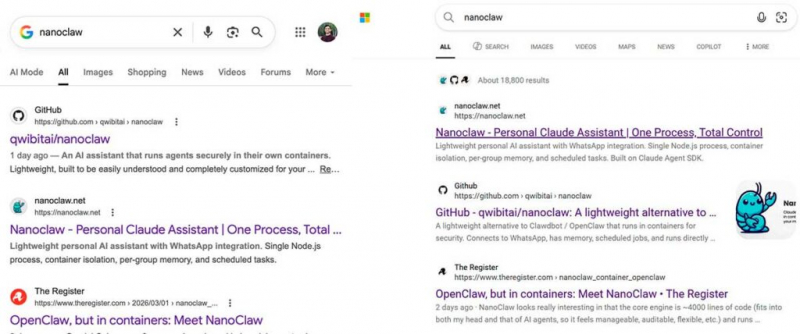
In tests conducted on March 5, the simulator site ranked first in Google search results by project name. The real site, nanoclaw.dev, did not even appear in the top few positions of the organic search results.
- The best Google result for the query “NanoClaw” was occupied by a fake site, which is higher than the real one in the search results.
- The developer sent the real URL to the Google Search Console, but was unable to oust the fake.
- The same fake page occupied positions in DuckDuckGo, Bing, Brave and other search engines.
- What happened
- The problem is in all search engines
- Why is this important
What happened
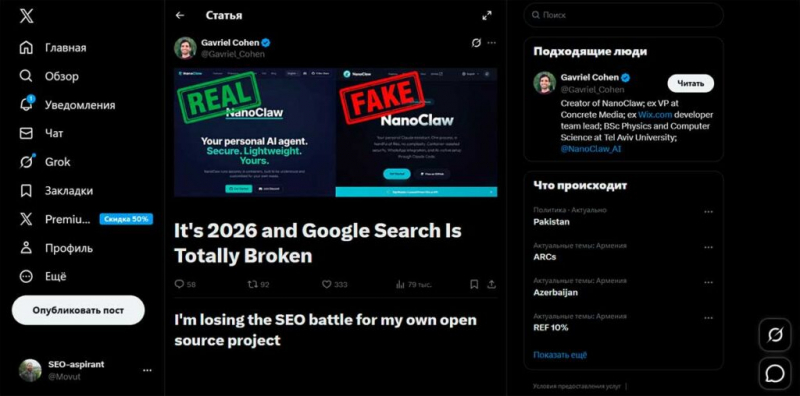
Gabriel Cohen, a software engineer and former Wix developer, posted a message on X describing the problem.
Cohen launched NanoClaw in early February as an alternative to OpenClaw, a popular open source security—oriented AI agent platform. The project grew quickly: it was covered by VentureBeat, The Register did a profile about Cohen, and popular AI researcher Andrei Karpaty publicly praised the architecture of the project.
On or about February 8th, someone registered nanoclaw.net and he created an automatically generated website copied from the project’s README file on GitHub. Cohen said that at that time he did not have his own website, since the repository on GitHub was a project.
As the project received press coverage, people started contacting him with concerns about “his” website. However, this site was not his.
Cohen created a real website on nanoclaw.dev and after that he took several standard SEO and error correction measures. He added structured data, posted a link to the site in a repository on GitHub, sent it to the Google Search Console, and filed copyright infringement notices with Google, Cloudflare, and the domain registrar. Publications covering the project referred to nanoclaw.dev.
By March 5, the fake site was still ranked higher in the search results than the real one.
In his post, Cohen stated that the fake website “actually provides incorrect information about the project and falsifies the publication dates.” He called the situation “a significant and active risk to user security,” because the person in charge nanoclaw.net , can at any time replace the page content with malicious download links or a phishing page.
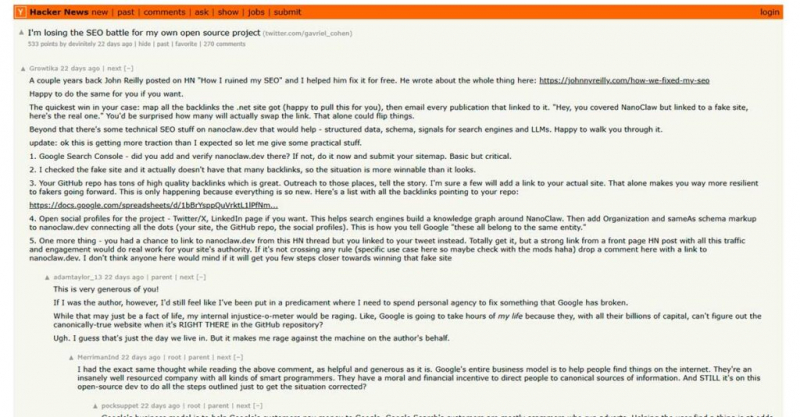
The Hacker News discussion about Cohen’s complaint garnered 315 votes and over 150 comments in just a few hours.
The problem is in all search engines
Commentators on Hacker News tested the same search results in other systems and found that the problem extends beyond Google.
One user noted that the fake site ranks first in DuckDuckGo and third in Kagi, while the real site does not appear in DuckDuckGo results at all. Another reported that Bing, Brave, Ecosia and Qwant are showing a fake website at the top. Mojeek turned out to be the only search engine tested that actually ranked the real site and excluded the fake one.
Why is this important
Earlier, John Mueller from Google argued that if copied content always ranks higher than the original, this may indicate a problem with the quality of the site. Mueller advised website owners to review their overall quality indicators if this happens all the time.
Cohen’s case once again confirms this logic. His project received 18,000 stars on GitHub, coverage from CNBC, VentureBeat, and The Register, support from Karpaty, and a blog post that won first place on Hacker News. All of his social profiles and the GitHub repository itself point to nanoclaw.dev. At first glance, many visible signals speak in favor of the real site.
The fact that commentators on Hacker News reported similar results in different search engines suggests something deeper than just a Google-specific error. One possible factor is the indexing time: the fake site seems to have been indexed before the real one launched.
For those who create a new product, the main conclusion here is to think about when is the best time to register a domain. Cohen focused on releasing the code before creating the website. This is standard practice in open source, but search engines indexed the simulator first, and it was much more difficult to fix the situation after that than most recommended steps suggest.