
The most profitable campaigns in terms of ROAS (profitability of advertising expenses) are those that take advantage of existing demand. And a review of ContentSquare with 99 billion sessions shows that the situation is only getting worse.

Brand search increases your ROAS score by attributing to you the demand that you already have, while all indicators in the paid customer acquisition model simultaneously deteriorate.
From this article you will learn:
- The math of how brand search distorts performance reports across the industry.
- Why using AI to detect opportunities will reveal these distortions faster than any audit.
- Specific recommendations for separating a truly new attraction from an expensive capture of existing demand.
The economics of performance marketing are deteriorating, but the main indicator that teams use to justify their budget hides the problem.
The ContentSquare analysis, based on 99 billion sessions, shows that all indicators of paid engagement are deteriorating at the same time. However, despite a 30% increase in advertising costs and a decrease in conversion rates, Google’s search advertising revenue still increased by 17% in the fourth quarter.
The data points to three hidden pitfalls in the ways performance is measured. Moreover, they show why the financial rationale for using AI in SEO only gets stronger with every dollar wasted on paid clicks that go away without conversion.
- Advertising costs increased by 30% last year, and conversion rates decreased by 5%
- You pay taxes on your own achievements
- The brand promotion budget protects 70% of the search and ignores the rest
- Rising advertising costs and high bounce rates suggest the need for AI-SEO
Last year, advertising costs increased by 30%, while conversion rates decreased by 5%
The best conversion rates are for those visitors who already know you… and paid clicks are those who are most likely to leave without conversions.
ContentSquare has measured the full path of customer acquisition in nine industries, and the picture remains the same everywhere: more investment means less value.
The cost per visit increased by 9.4% in 2025, which added to a cumulative increase of 30% over three years. At the same time, conversion rates decreased by 5.1%.
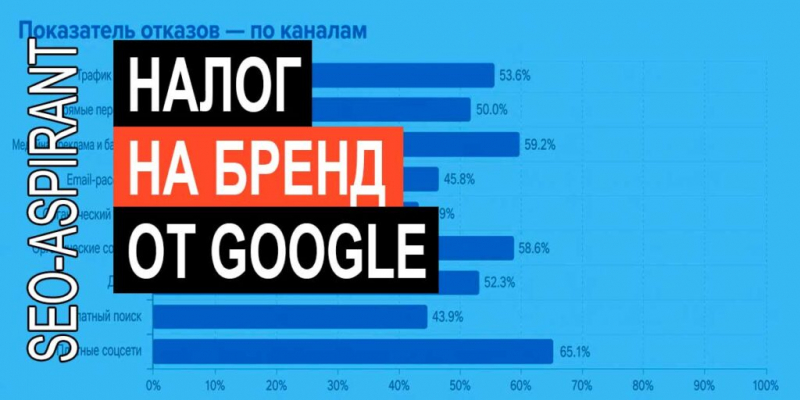
But the analysis showed that the bounce rate in paid search is 59%, in advertising on social channels — 65%, while the bounce rate for organic visits is about 42%. The channel conversion rate is very tight: 2% for paid search, 1.6% for display, 0.4% for paid social channels, and 1.8% for organic search.
These bounce rates mean that more than half of every dollar spent on paid search results in a visitor who leaves without viewing any other pages. Paid impressions on social media are even worse. Every indicator in the attraction model is getting worse… all at the same time.
Gallan Chen, development Advisor for companies such as Shopify, DocuSign, New Relic and others:
My clients have experienced something similar. Usually, sometime in the first half of 2025, most of my clients noticed a decrease in total paid search traffic (branded and non-branded) combined with an increase in CPC (for example, a 20% decrease in clicks, but a 20% increase in CPC). In fact, Google implemented AI Overviews (AI answers) and at the same time tried to maintain a stable income. The introduction of AI Overviews has reduced the number of clicks. But those advertisers who did get clicks started paying more for them. As a result, Google did not have to sacrifice revenue to fully switch to AI Overviews.
Most likely, AI Overviews and AI Mode at Google will continue to accelerate this process. According to Semrush, in the fourth quarter of 2025, approximately 16% of search results show AI-generated answers, and this figure is growing.
Reducing the number of available clicks does not necessarily reduce the demand for advertising, but it does focus bids on fewer clicks, which leads to higher cost per click.
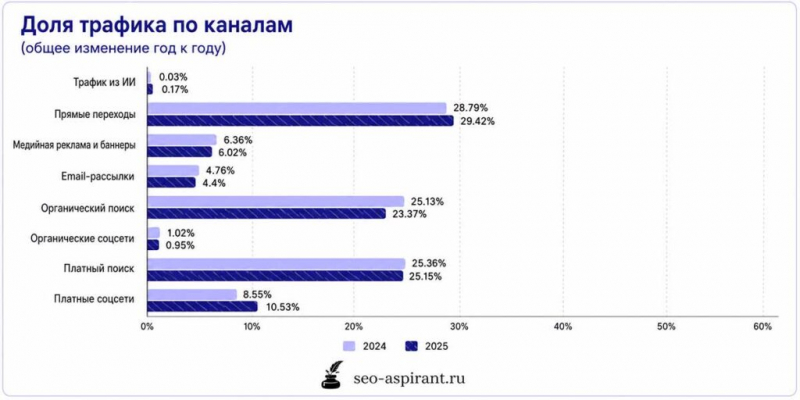
One of ContentSquare’s discoveries compounds the problem: repeat visitors — the 13% who return within 30 days —account for the majority of conversions on many sites. The traffic attracted through AI still accounts for only 0.2% of the total number of visits, but such visitors leave less often and convert slightly better than organic traffic.
You pay taxes on your own achievements
If all the indicators of traffic acquisition are deteriorating, why do most dashboards still consider paid search as the most effective channel? Because brand search does the main job, and brand search is not about attracting new customers, but capturing existing demand.
Dreamdata’s analysis of Google Ads accounts in the B2B segment showed that 18% of the search advertising budget — approximately $47 billion — is spent on branded keywords. Brand search campaigns account for 1,299% of ROAS, while non—brand campaigns account for 68%. This difference looks like a success story until you check if the advertisement really triggered the sale.
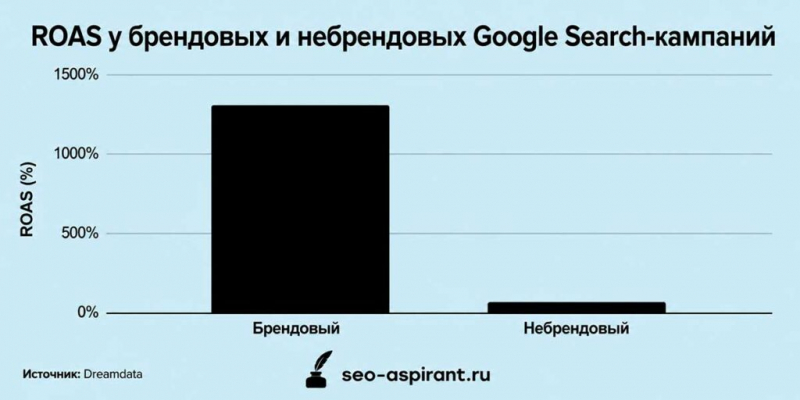
In 2024, Rand Fishkin explained the attribution mechanism that causes invisibility: when people learn about a brand through social media, podcasts or word of mouth, they go to Google and search for the name the brand. Google gets paid for the conversion. CFOs look at analytics and see that the best traffic comes from Google, which strengthens investments in Google Ads.
The more a company invests in brand development in other channels, the better brand search performance looks, and this makes Google the most effective channel… which encourages even more spending on Google.
Google charges for conversions that have nothing to do with it, and if you take measurements carelessly, it can distort the real picture. In a conversation with Rex Gelb, founder and CEO of Summit Chase and head of paid media at Cursor, he noted:
Brand search is one of the most underestimated indicators in performance marketing. High ROAS for brand campaigns usually reflects the demand that has already been generated by your marketing efforts in other channels. This doesn’t mean that branded search is useless — it often protects conversion paths and captures traffic with high intent. The biggest mistake is to count the average ROAS without separating branded and non—branded traffic. After the separation, the economics of customer acquisition become much clearer.
Gallan Chen supports this idea:
My preferred approach is to consider paid brand search as “operating expenses”, similar to other items of the general and administrative budget, which, unfortunately, have to be invested in order for the business to function. Brand search does not generate additional revenue. Focus on non-branded search, which really generates additional revenue.
The brand promotion budget protects 70% of the search and ignores the rest
Justifying brand costs would be easier if Google were the only search destination… but you and I know that’s not the case. Brand keyword protection does nothing to search on Amazon, YouTube, Reddit, or any AI platforms.
SparkToro and Datos have published a study analyzing user behavior when searching on desktop computers for 41 domains:
- About 80% of search queries originate in traditional search engines (Google is responsible for 73.7% of all searches on desktop devices).
- Trading platforms occupy approximately 10% (for example, Amazon and eBay), social networks — 5.5% (TikTok, YouTube), AI tools — 3% (ChatGPT, Claude).
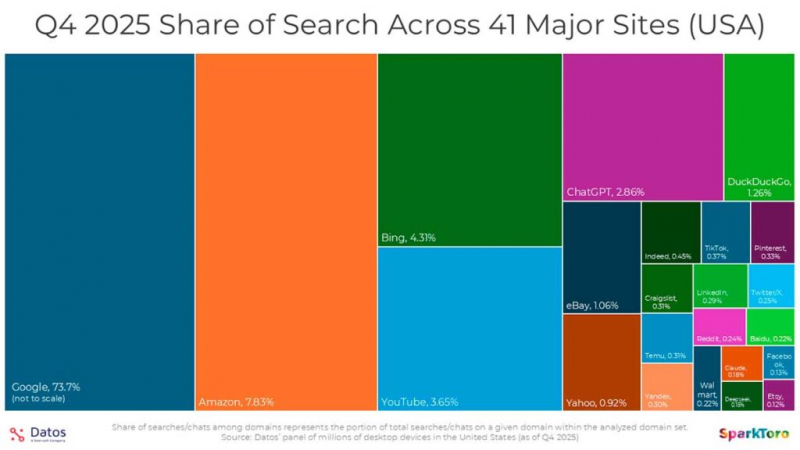
Brands pay to protect their name on a platform that accounts for 70% of search queries, while this platform is actively declining (albeit slowly), and the search for new customers is shifting to areas where the brand tax does not apply:
The most impressive thing for me is that no one notices. Thirty-four sites outside the top 7 are increasing their search share — this is one of the few areas of web behavior over the past decade, if not the entire history, where the largest sites are not becoming more dominant over time. I hope this trend will continue.
A brand that spends 90% of its advertising budget on Google is being optimized for a single platform in a search economy that now includes 41 or more sites — and 34 smaller sites outside the top 7 are becoming the fastest growing search segment. This creates new risks.
The math doesn’t add up when you consider where people are really looking for products, answers, and recommendations.
The rising cost of advertising and high bounce rates suggest the need for AI-SEO
If impact is more important than traffic — and it is, although it is more difficult to measure — brands should build a presence on platforms where their audience is already spending time, rather than (expensively) luring them with paid clicks.
The audience retention data from ContentSquare confirms this: repeat visitors returning within 30 days are converted several times better than paid visitors on the first touch. Visitors attracted by AI come with clearer intentions thanks to AI dialogues, leave less and convert closer to organic traffic indicators.
The structure repeats. Brand awareness, created before the click, can provide better economic performance than paid recruitment during the click itself.
This is one of the main financial arguments in favor of AI-SEO, even if it is now difficult to accurately estimate the ROI of visibility in large language models.
If more than half of every dollar spent on paid search is rejected — and AI Reviews are likely to increase this figure — then investing in brand visibility and trust within AI responses makes financial sense for many brands.
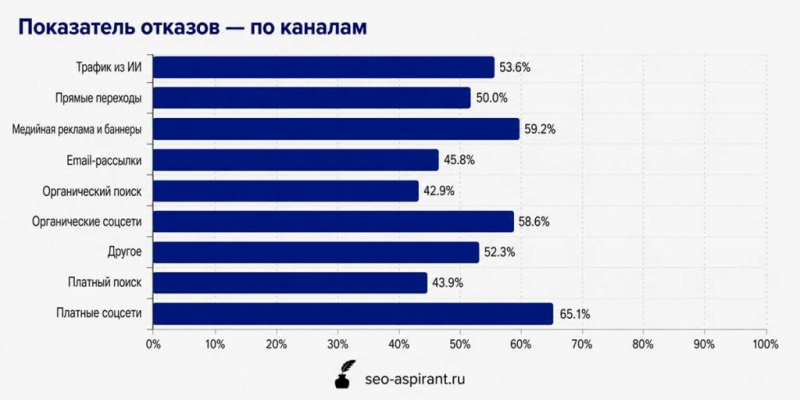
This does not mean that “AI-SEO is against proven ROI”. It’s more about “AI-SEO versus an ever-worsening high bounce rate.”
A channel that builds brand awareness in the early stages and balances your dependence on paid demand attraction does not need attribution confirmation in the same way as a direct response campaign.
It should be ensured that the cost of brand search is reduced without affecting the overall profitability. Any company interested in its own growth can conduct such research for itself.