
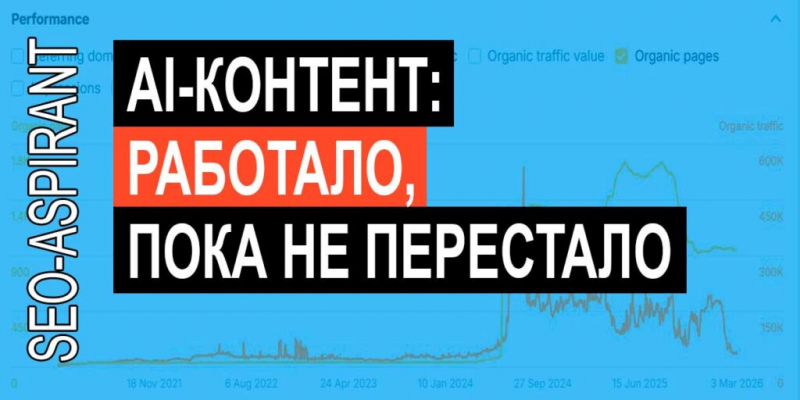
The tools keep changing. The wall they’re crashing into isn’t.
Every few years, the SEO industry discovers a new way to mass produce content and convinces itself that this time it will work. That the huge volume of pages will overload Google’s ability to evaluate quality. That if you just publish a lot, then the numbers will decide everything for you.
And it never works. It never worked. And the people selling you these methods know that it has never worked. They just need it to work long enough to collect the money from you.

- This model is called “Learning Disability”
- 2008-2011: chaotic Content Spinning
- 2015-2022: Programmatic SEO
- 2023–present: AI-generated content on a large scale
- The wall of quality is not moving
- Google has already told us this many times
- “But our content ranks well”…
- Economics doesn’t make sense
- Same mistake, better tools
- The only important question
This model is called “Learning disability”
Let’s study the history of SEO, because, apparently, you and I need to understand again what has been happening all these years.
2008-2011: chaotic Content Spinning
The explanation was simple: take one article, run it through a program that changes synonyms, and suddenly you have 50 “unique” articles. The word “unique” did most of the work in this sentence. These articles read like someone was passing a dictionary through a blender. But even if the final result had been polished, there was no trust in it.
Here’s what the creators of hyped content have never understood and what all their successors still don’t understand: uniqueness is easy to reproduce. A monkey who drops his hands on the keyboard creates unique content. The character string has never existed before — congratulations, it’s original. The hardest part wasn’t creating uniqueness. It’s about creating a uniqueness that’s worth something. Unique and valuable are not synonymous, and the gap between them is exactly where the whole scaling strategy breaks down.
Google has been putting up with this for a while. His systems just weren’t ready for it yet. Then in February 2011, Panda appeared, affecting almost 12% of all search queries, and content farms saw their traffic disappear overnight.… I happened to be watching this in real time. Demand Media, a prime example of a content farm model, recorded a loss of $6.4 million over the next year.
The lesson was obvious: quality cannot be mass-produced as a product of industrial production. A volume without content is a massive tail of obligations that most budgets cannot sustain.
2015–2022: Programmatic SEO
Explanations have evolved. Instead of tweaking existing articles, we started creating templates and filling them with structured data. Pages like “The Best [X] in [The City]” generated by the thousands, each of which is a thin wrapper around a database query. Some of them were really useful — if the source data was good and the template met the real needs of users. Most of them didn’t make sense. Most of them were just well-designed landing pages. Google has spent years improving its ability to identify and downgrade boilerplate content that existed more for indexing than for users.
The lesson should have been learned: scale works when it has content behind it. Without it, you’re just creating a big pile of garbage.
2023–present: AI-generated content on a large scale
And here we are again. The same approach, only with more modern tools. “We can produce 500 articles per month!” Great. Can you create articles that will be read? Which contain something that the user can’t find in the existing search results? Which really demonstrate experience, knowledge, or original thought?
No? Then you don’t scale the content. You’re scaling up a waste of your crowling budget.
I recently came across an AI visibility assessment tool — one that positions itself as an assistant in AI system detection — and it generated hundreds of pages based on the template “the best SEO agencies in [the city]”. Deja vu again. Anyone who has lived through the era of software SEO will immediately recognize this scenario — this is the playbook of 2017, only now the copying is done using AI. The template received a grammar update and the stamp “this is AI”. The strategy remains the same.
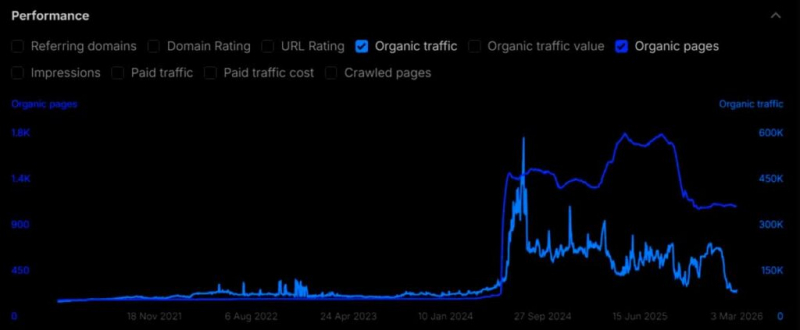
I mentioned a similar case in my Telegram channel: a resume website containing more than 500 program pages with an “example resume for [job title]”. Each name follows exactly the same formula. Almost identical page templates. Incorrect use of the AggregateRating scheme. Obvious AI content all over the site. Her short description is three words: “it worked until it stopped.”
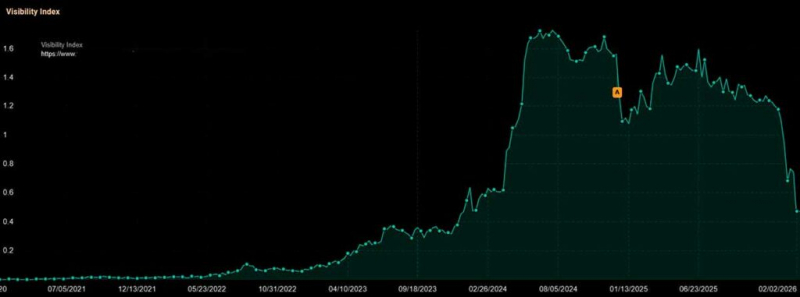
This phrase should be tattooed on every presentation slide about content scaling. “It worked until it stopped.” And that’s how it always happens. And then everything ends.
The irony that an AI optimization tool that uses mass landing page creation to increase website visibility would be comical if it didn’t match the industry’s history so perfectly.
The wall of quality is not moving
That’s what changes the scale of the content every time. Google does not evaluate content in isolation. It compares it with everything else in the index on the same topic.
Publishing 500 AI-generated articles about mortgage rates does not make you an authority in this field. This makes you the 500th source to say the same thing in a slightly different way. And Google already has 499 of the same sources. Thank you, I don’t need yours.
The wall of quality is as follows: there is a minimum threshold of true value — original ideas, life experience, specific knowledge, something that the reader will not be able to find elsewhere — below which no number of pages will help you. You can publish a million pages below this threshold, but you won’t take anything in the SERP for important queries.
And the situation is getting worse nowworse. For those who scale AI content specifically to gain visibility in AI-based response systems, the volume strategy doesn’t just fail — it actively backfires.
In 2025, a scientific article was published on the search evaluation metric for systems of the era of large language models, which measures both useful and distracting fragments when sampling information. Low-value content doesn’t just quietly wait for no one to read it. It can confuse search models, impairing the quality of the responses that these systems generate.
Your 500 weak articles are not only invisible noise, they are a hindrance. And if your site has really useful pages hidden among this noise, congratulations — you’ve created your own pattern interference. Volume, which seemed like a way to help you discover content, actually drowns the pages that could provide it.
This is the same understanding that the content scammers ignored in 2010, the software SEO factories in 2018, and now the AI content workshops are ignoring. The tools have become better at creating text. But this text doesn’t really mean anything anyway.
Google has already told us about this, many times
Google’s anti-spam policy defines abuse of scaled content as the creation of pages “primarily to enhance search positions, not to help users.” They explicitly point out that using generative AI tools (or similar ones) to mass produce pages without adding value is an example of such abuse. This is not a hidden hint. It’s written right there.
In June 2025, Google began to manually take measures specifically against abuse of scaled content, targeting sites that massively published AI-generated content. Many sites in the UK, USA, and EU have received notifications in the Search Console indicating “aggressive spam techniques” and “massive content abuse.” The overall visibility of the page drops dramatically. They don’t just go down in the organic search results — they disappear.
The anti-spam update in August 2025 continued to tighten measures. Subsequent updates to the core of Google’s search algorithm continued to tighten the screws. The same profile suffers every time: high volume, low quality of content, lack of editorial control.
And every time the website owners are surprised. It’s like Google hasn’t told them this for 15 years in a row.
“But our content ranks well”…
This is my favorite illusion. I’ve seen her at every stage of this cycle. “Our AI content is ranked, so everything is fine.” Claiming “it ranks well” is exactly why Google releases algorithm updates and manually punishes sites. If your low—value content is ranked, it means that the system just hasn’t reached you yet. That’s all!
Google collects signals not only from a single page, but also from the entire site. You can create individual pages that work well, while the overall quality signal of the site deteriorates. And when retribution finally catches up with you (algorithmically or manually), the bot doesn’t just delete pages one at a time. It affects everything at once.
This is the lie of the content scammers, which is regularly repeated: “this is working right now, so this is a strategy.” Demand Media’s content was also at the top — until it stopped being there.
Here is another case from the same topic: “SEO case: “scaling content using AI works – look how our views, clicks and sales have grown!” Reality: “and then comes the collapse of traffic that inevitably comes. Every success story of such scaling is a snapshot taken before the situation is fixed. No one is publishing a sequel.
The economy doesn’t make sense
Let’s put the risks aside for a minute. Let’s talk about what you actually produce.
Five hundred AI-generated articles per month. Each one needs to be checked for accuracy, because large language models are prone to hallucinations, and publishing incorrect information is a risk that goes beyond SEO. Each one needs to be checked for originality, because if the text reads like everything else in the index, it does not add value and does not give a competitive advantage. Each one needs to be reviewed editorially to make sure that it really serves the audience it is intended for.
If you’re doing all this, then the costs have just shifted—and maybe even increased—even though you’re assuring yourself that you’re working efficiently. The “efficiency” of AI-based content generation disappears the moment you apply to it the quality standards that content really should have.
And if you don’t? Then you publish massively raw, unedited, potentially inaccurate content under your brand. To be honest, I don’t understand how anyone can approve of this.
Same mistake, better tools
Content promotion. Software SEO. Mass content creation using AI. Three different tools, the same error. Looking at content as a production task in a factory.
Production involves creating the same results on a large scale — that’s the point. But the value of content comes from exactly the opposite: from concreteness, from experience, from saying something unique that is not present in the rest of the index. Every attempt to industrialize it faces this contradiction.
You cannot automate concreteness. You can’t template the experience. It is impossible to create original ideas by simply running an AI model and hoping that something useful will turn out. And these limitations will not disappear with the release of the next model. They are embedded in the very essence of what makes content worth reading initially.
Those who chase scale all the time optimize the wrong variable. They see “more content” as an input, which gives “more traffic” as an output. But this function is not linear. And she wasn’t like this before. It is limited by quality, and no amount of volume will circumvent this limitation. Unless you are making doorways with an initially limited service life.
The only important question
Before you post anything (with or without AI), ask yourself one simple question: what does this page offer the reader that they can’t already get?
If the answer is “nothing, but we have more pages in the index,” then you are not building a content strategy. You’re building a risk for yourself. And you do it with the confidence of someone who, apparently, has never heard of Panda, has not looked at what happened to software SEO sites in 2022, and has not read Google’s anti-spam policy.
You can convince yourself as much as you want. But sooner or later you will find yourself in the place of the losers.
The wall is still there. It has always been there. The tools change, but the wall doesn’t.