

A new study among U.S. workers shows that 14% of them report “brain overheating” from excessive use of AI. Among them, marketers have the highest rate — 26%.
An article in the Harvard Business Review, prepared by researchers from the Boston Consulting Group and the University of California, Riverside, reports that 14% of the 1,488 full-time employees surveyed based in the United States have experienced what the authors call “brain overheating.”
By this they mean mental fatigue caused by excessive use, interaction, or control of AI tools that exceed human cognitive capabilities.

- What the study found
- Brain fatigue leaders are marketers
- Business Value
- AI can reduce burnout
- Why is this important
- A few words about the methodology
- A look into the future
What the study found
The study revealed that the most time-consuming form of interaction with AI is monitoring its work. Workers who noted that their AI tools required a high level of direct monitoring expended more mental effort and reported greater fatigue compared to those with lower monitoring requirements. A high level of control was also associated with a 19% higher information load.
The second key factor is whether AI has increased the overall workload of the employee. According to the authors, the combined impact of control and expansion of the work volume increase the so-called “sphere of responsibility” of the employee, requiring attention to more tasks and tools in the same time.
It also seems that there is a limit to how many AI tools one person can effectively use. The perception of increased productivity increased with the transition from one to two tools, and then from two to three, although at a slower rate. After three tools, productivity indicators began to decline.
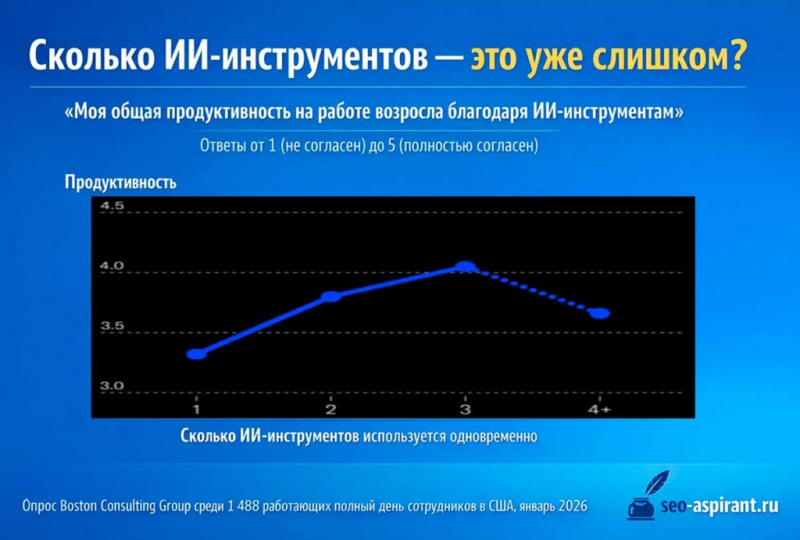
The study notes that many of those who use AI most intensively are “modern superstars, talents that the company must retain.” People who have reached the cognitive ceiling are not casual users. They are, in a way, pioneers and high-performance workers.
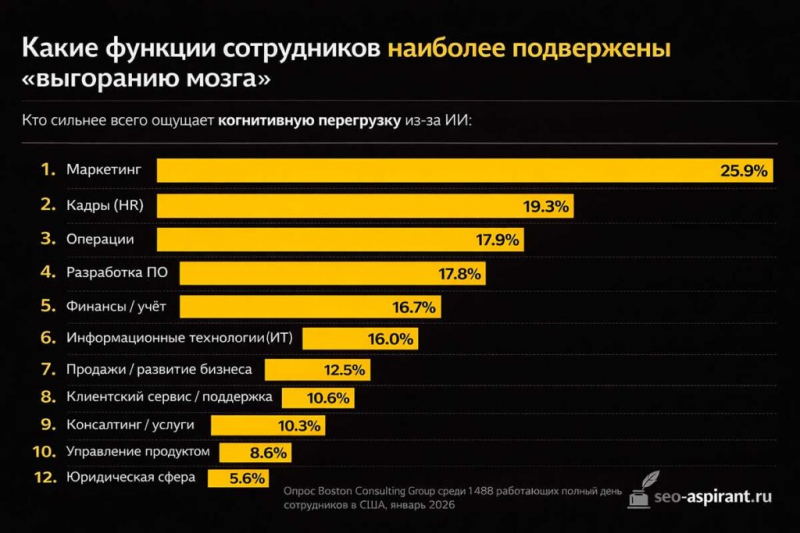
The leaders in brain fatigue are marketers
Marketing turned out to be the leader in the level of “brain overheating” — 25%. Next are HR and people operations — 19%, operations teams — 17% and development/engineering — also 17%. Finance and accounting are slightly behind (16%), as well as IT (16%). The lowest figure is for legal and compliance departments — only 5%.
Employees described feeling “buzzing,” mental fogginess, and slow decision-making. Many employees said they literally had to leave their computers to “reboot.”
One of the financial directors quoted in the study described this experience as follows:
“I constantly corresponded withAI, reformulating ideas, synthesizing data, shaping and organizing the flow of ideas and tasks… I couldn’t even figure out if what I had created made sense… I just couldn’t do anything else and had to go back to work the next day when I could think clearly.”
Business value
Workers who experienced “brain overheating” showed 33% higher levels of “problem-solving fatigue” than those who did not. They were also more likely to make mistakes: the rate of minor errors was 11% higher, and major errors by 39%.
There is also a connection between “overheating of the brain” and the desire to leave work. Among employees without signs of fatigue, more than 25% showed an active desire to quit. For those who had “overheating”, this figure rose to 34%, which is 39% more.
AI can reduce burnout
The study makes a distinction between burnout and “brain overheating.” Burnout is mainly associated with emotional fatigue, whereas “brain overheating” is acute cognitive stress caused by the fact that attention and working memory have exceeded their limits.
When employees used AI to replace routine or repetitive tasks, their burnout rates were 15% lower. However, the same usage did not reduce mental fatigue.
Researchers believe that this is understandable: freeing up time from boring work allows you to focus on more interesting tasks, which has a positive effect on your emotional state. However, intensive AI monitoring puts a strain on another system.
Managerial and organizational practices are also important. Employees whose supervisors took the time to answer their AI questions experienced 15% less mental fatigue. Those who felt that their organization expected more from them because of the use of AI showed 12% higher rates of fatigue. And employees who felt that their organization valued work-life balance showed 28% less mental fatigue.
Why is this important
These findings help to understand the real impact of AI on the workforce.
A Yale University study published last year showed that after 33 months, there is no evidence that AI has displaced workers from highly automated professions. And a survey of more than 4,000 PwC CEOs conducted earlier this year showed that 56% of them saw no revenue growth or cost reduction due to AI.
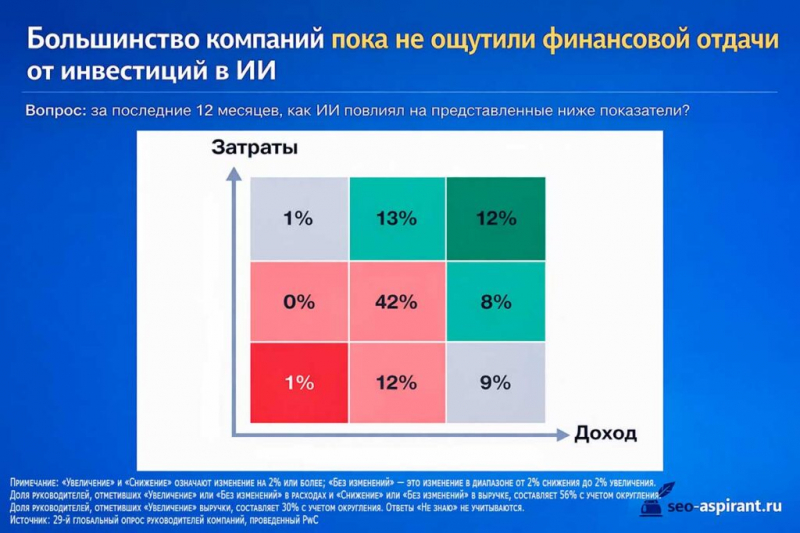
This study adds a different perspective. AI may not be destroying jobs in marketing, but evidence indicates that it can burn out workers, especially those who operate multiple tools at the same time.
For marketing teams and agencies using AI in content creation, analytics, and advertising platforms, the three—tool productivity limit and a 25% “brain overheating” rate are important factors to consider when organizing work.
A few words about the methodology
The survey covered 1,488 employees from the United States (48% men, 51% women; 58% individual performers, 41% managers) from large companies of various industries, roles and levels. The survey was conducted in January 2026. Full details can be found in the Harvard Business Review article (link above).
A look into the future
In an interview with CBS News, Julie Bedard, managing director and partner at BCG, as well as the author of the study, called the findings a “warning signal” rather than a reason to stop using AI.She said:
“AI can go far ahead, and we are still left with the same brain that was yesterday.”
As companies ramp up their use of AI and demand more from the same teams, this study warns that the cognitive costs of expansion must be factored in alongside profits and productivity gains.
The authors recommend limiting the number of AI agents monitored by one employee and refraining from adding new work, as AI speeds up the completion of tasks anyway.