
An SEO specialist’s experiment in publishing misinformation shows how easy it is to gain high positions in Google Search and AI Overviews with false information in 2026.

An SEO specialist who created a news article using AI noticed a fiction about a non-existent update to the Google core in March 2026 and decided to publish it as an experiment. to check how the misinformation is spreading.
While publications in industry publications ignored fake news, some independent SEO specialists noticed it and distributed it without verifying the actual accuracy of this information.
- Is the error surprising?
- Google ranks disinformation
- Example of a query for which Google recommends ineffective black SEO tactics
- Sites repeat misinformation
- Most news sites ignored the fake update
- Google has its own way of checking facts
- Key findings
Is the error surprising?
The person who conducted the experiment, John Goody (LinkedIn profile), published an article on LinkedIn that specifically contained a fictional AI message about a non-existent Google core update in March 2026. He explained in a subsequent LinkedIn post that his workflow with AI includes human quality control to identify AI errors. When he saw the error, he decided to post it to see if anyone could refute or challenge this false information.

Google ranks misinformation
Goody explained that it was Google itself that inflated the misinformation about the fictional update of the kernel algorithm his LinkedIn article took over the first page of Google with the phrase “Google March 2026 Update.” The fake news was also displayed in the classic Google search and in the AI Overviews section.
He explained:
“My LinkedIn article started to occupy the first page of Google for the query “Google March update 2026”. Not on the third page. It was visible to everyone who was looking for information about the latest Google algorithm changes.
…Google’s AI Overview interface itself took on this made-up information and presented it as fact.”
Google’s fact-checking in search results is almost non-existent, so it’s not surprising that the search engine ranks fake information, especially regarding SEO. Using Google to search for SEO queries is like playing slot machines: it is not known whether the information is true or a complete fiction.
An example of a query for which Google recommends a non-working black SEO tactic
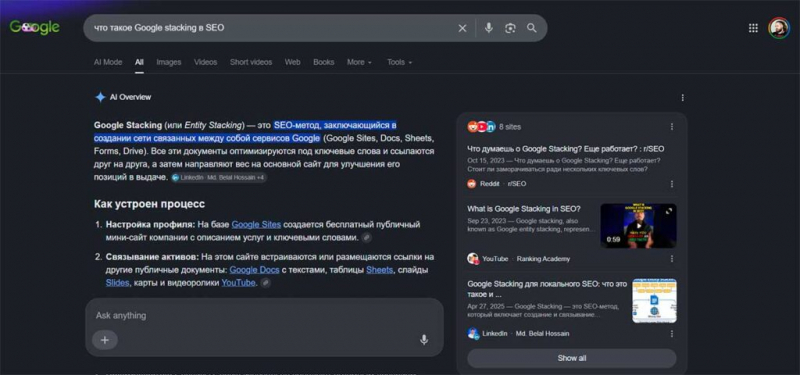
Searching for information about questionable black SEO tactics (for example, stacking on Google) can lead to Google actually confirming it, which potentially misleads an honest businessman or a novice webmaster who will not understand it.
This is a long-standing problem inGoogle’s search results, and so it’s not surprising to see Google spreading misinformation about a fictitious update to its search algorithm.
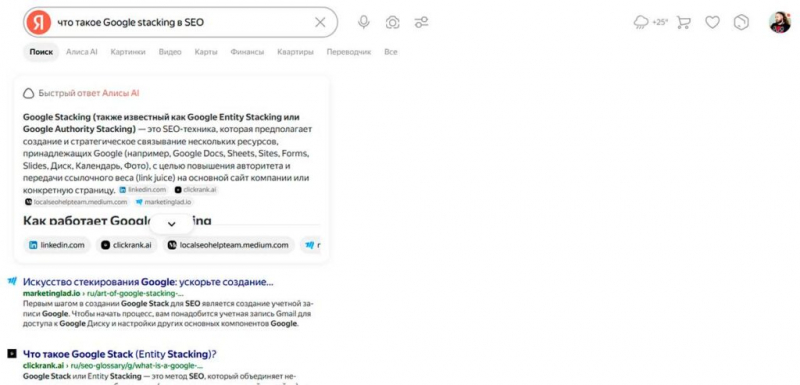
Similar example from Yandex:
Sites repeat misinformation
As a result, SEO sites started spreading false information about the update, because of course, major updates to Google’s core attract traffic and serve as a way to attract potential customers for SEO agencies.
It has long been a practice in the SEO community to stir up hype about non-existent updates, so it’s not surprising to see SEO agencies picking up on this topic.
Goody shared:
“Many sites published detailed, authoritative articles about the “March 2026 Kernel Update”, considering it a confirmed reality. These were not ordinary blog posts, but detailed materials with specific statements about Gemini 4.0 Semantic Filters, Information Gain metrics, and recovery strategies.”
Most news sites ignored the fake update
Search Engine Journal and their competitors ignored the news about the fake March update. But some people don’t, apparently, and Goody spoke about it.
He wrote:
“Another site, TechBytes. went even further with the material by Dilip Choudary under the title “Google March 2026 Core Update: Cracking Down on ‘Agentic Slop’.” (Oh, what an irony…).
Specific technical details were made up in this article, including claims about the Gemini 4.0 Semantic Filter, the Zero Information Gain classification system, and the Discover 2.0 engine, which prioritizes long technical narratives.”
Google has its own view on fact checking
Google’s Danny Sullivan said that Google doesn’t do fact checking. However, there is a separate news report published in Axios related to fact-checking, where a Google representative confirms that Google will not comply with EU law requiring fact-checking.
According to the news:
In a letter sent to Renate Nicolai, Deputy director of Content and Technology at the European Commission, Google’s president of International Affairs, Kent Walker, said that the integration of fact-checking required by the new Code of Practice on Disinformation is “simply not appropriate or effective for our services,” and Google is not committed to fulfilling this requirement.
The code would require Google to include fact-checking results in search results and YouTube videos. He would also force Google to integrate fact-checking into its ranking systems and algorithms.
Walker said Google’s current approach to content moderation is working, and pointed to the successful moderation of content during last year’s “unprecedented international election cycle” as proof.
He noted that a new feature added to YouTube last year that allows some users to add contextual notes to videos “has significant potential” (this program is similar to the Community Notes feature in X, as well as a new program announced by Meta).
Key findings
John Goody made several important conclusions, and the most important of them is that people should independently verify the facts they read on the Internet if they want to receive reliable information, not fakes.
Other conclusions:
- Verification mechanisms should be built into AI workflows.
- Most readers don’t check the facts (only a few commentators have refuted the false claims).
- AI responses and search reinforce misinformation.
- Some repeat articles found on the Internet, while others repeat and embellish the original false information.