
Data on 4 million AI citations shows that syndicated press releases are hardly used in AI responses. Editorial content and own news resources show the best results.

A BuzzStream report based on an analysis of 4 million AI citations showed that press releases distributed by through syndication channels, they are practically not found in AI-generated responses.
- Background
- Results
- What the analysis shows
- Exception — ChatGPT news
- Why this is important for SEO
- A look into the future
Background
Press release distribution services promote “visibility in AI” as one of the advantages for customers.
For example, ACCESS Newswire offers a special “AI visibility Checklist” for press releases. eReleases has published a guide in which it positions press releases as a tool to increase visibility in AI search. Business Wire wrote about ways to optimize press releases for detection in “responsive” search engines.
However, BuzzStream’s data offers a different perspective.
Results
The authors of the report used XOFU, a citation monitoring tool from Citation Labs, to track the sources accessed by AI platforms: ChatGPT, Google AI Mode, Google AI Overviews and Google Gemini. BuzzStream tested 3,600 queries in 10 industries and collected data for a week.
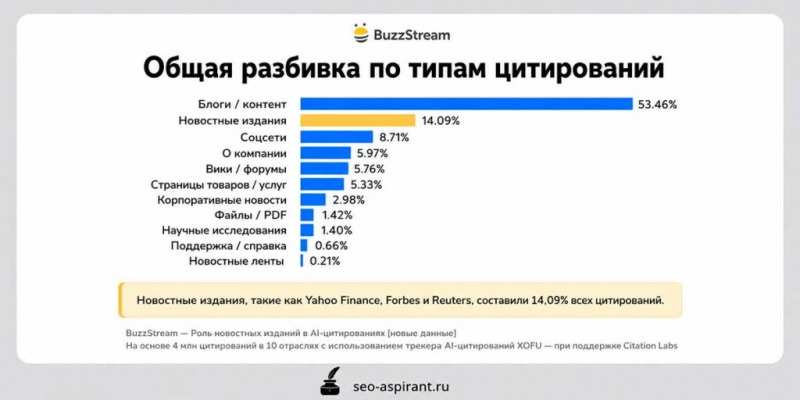
In general, news publications accounted for 14% of all citations in the sample. But among this category, the number of links to syndicated and distributed materials is sharply decreasing.
Press releases published through syndication channels such as Yahoo and MSN accounted for 0.32% of news citations and just 0.04% of the entire dataset.
Direct quotes from news agencies such as PR Newswire took up 0.21% of the entire dataset. They were most often found in “intelligence” and information queries, but even there they reached only 0.37%.
In general, syndicated news content, including articles republished via MSN and Yahoo networks, accounted for 6.2% of citations in news and 0.9% of the total data set.
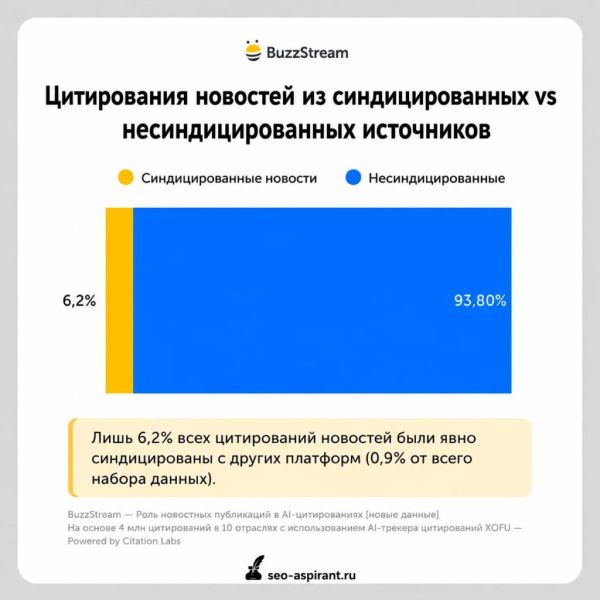
To identify syndicated content, BuzzStream matched the names of authors with publications using its ListIQ tool and manually confirmed cases where the author’s name did not match the name in the publication. The company acknowledged that this method has its limitations, as some sites republish press releases without attribution.
What the analysis shows
More interesting information is which sources are still being cited.
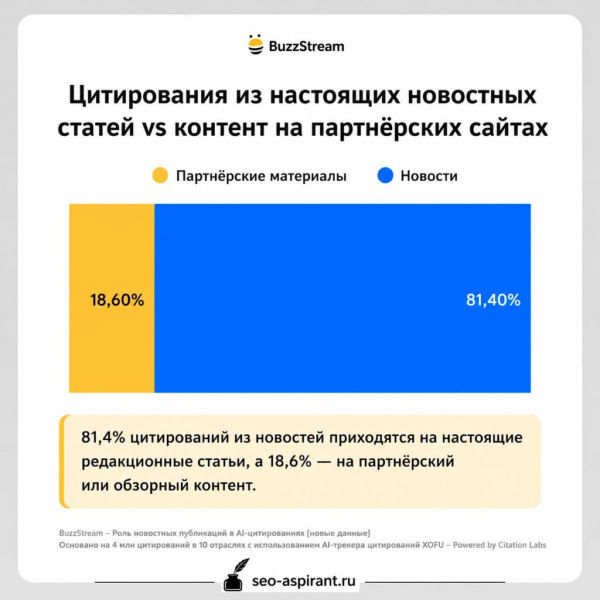
Original editorial content accounted for 81% of all news citations in the sample. The rest was taken up by affiliate materials and reviews. This ratio was maintained for all types of queries, although the share of partner content was the largest in estimated queries — 39%.
In the report, the queries were divided into three categories. Evaluation queries, for example: “Is Sony better than Bose?” — generated the most news citations (18% of all links). Brand awareness requests, for example: “What is Chase known for?” — generated the least (7%). Information requests were located between these values.
The editorial content that was most often cited in evaluation requests included face-to-face comparisons and cost analysis from publications such as Reuters, CNBC and CNET.
The exception is ChatGPT news
One platform stood out noticeably. Internal press releases and materials from news sections on official company domains accounted for 18% of all ChatGPT citations in this report.
On Google’s AI platforms, this figure was about 3%.
BuzzStream provided examples, including the Iberdrola corporate press center and the Target corporate subdomain. When ChatGPT was asked about Iberdrola’s role in the field of renewable energy, he referred to a press release from the official Iberdrola website. And when you request information about Target products, you can send it to a 2015 press release from the Target corporate domain.
According to BuzzStream, most of the previously identified trends were fairly uniform across all platforms, but the materials from the ChatGPT press centers stood out as a clear exception.
Why is this important for SEO
These data call into question the arguments that are being promoted by press release distribution services. Many platforms are now positioning press releases as a way to increase visibility in AI responses.
BuzzStream data shows that AI systems most often quote not the syndicated version of a press release – the one published on Yahoo Finance or MSN through news services – but editorial publications on original websites or materials from their own news sections companies that work much more efficiently.
This is due to the trends that we are observing right now. In January, a BuzzStream report was already published, according to which 79% of leading news publishers block at least one AI bot for training, and 71% block bots for searching and extracting information. According to Hostinger’s analysis, 66 billion requests from bots have shown that access to AI bot training is limited, while search bots are increasing their presence.
Citation data suggests that even if syndicated content is available to AI bots, it rarely appears in their responses.
In a recent interview, Robby Stein, Google’s vice president of search product, said that mentioning on other sites can help with AI recommendations by comparing the AI’s work with how a person studies a question. This approach benefits editorial coverage, rather than syndicated press releases.:
Adam Reimer also noted this in his column “Ask SEO”, emphasizing the difference between digital PR, which builds brand awareness in publications, and link building, which relies on quantitative placement indicators. BuzzStream data shows that this difference extends to AI citations as well.
For greater transparency, BuzzStream sells tools for outreach and digital PR, so their conclusion that “well—deserved” publications work better is consistent with the company’s interests. To collect the data, BuzzStream collaborated with Citation Labs using their XOFU tool.
A look into the future
This material is the first part of a series of analytics from BuzzStream. The one—week data collection period and the focus on large brands are limitations worth keeping in mind. For smaller brands with fewer editorial publications, the results may be different.
It is useful for businesses investing in digital PR to take a closer look at how different distribution channels work in their niche. The data shows that the chosen channel affects where your brand will be mentioned by AI.