
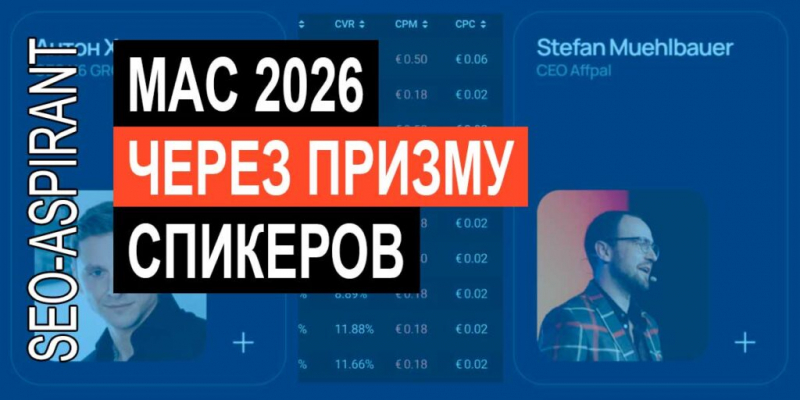
The MAC-26 in Yerevan will be held at the end of May, and the organizers have begun to reveal the first wave of speakers. It is important not so much that this is another big event, but rather which people were brought to the front line of the announcement: there is a dating expert, a DTC/performance entrepreneur from the CPC niche, the CEO of a large CPA network with a strong educational background, a Telegram entrepreneur and a separate Telegram Ads practitioner with a master- the class. All this is very similar to a signal that the market is moving away from the “fill where it pours” model towards the “acquisition + operations + retention + distribution” model.
This logic is well explained by the external background of 2025-2026. In iGaming, money goes to regulated and large markets like Brazil, where only authorized operators operate from January 1, 2025, and the monthly volume of bets, according to Reuters, citing the Central Bank, reached 30 billion reais.
At the same time, large public companies in the sector are directly talking about instability in organic search, the fight against spam and low-quality SERPs, and the need to diversify traffic sources. At the same time, digital advertising in the United States grew to almost $300 billion in 2025, and the affiliate model is increasingly focused on content creators, AI, and alternative attribution.
For the SEO/affiliate audience, this leads to a completely applied conclusion: just a website, just an offer, and just traffic no longer look like a sufficient design. The winner is the one who gets deep analytics, knows how to build their own distribution, localize GEO and not depend on one platform, one cabinet or one type of traffic.

- What the speaker list already says
- What trends should be read between the lines
- What does this mean for SEO, webmasters and arbitrators
- Set the KPIs deeper than the lead and registration
- Add your own distribution
- Test GEO as a portfolio
- Conditional examples from practice
What the list of speakers already says
The first wave of MAC-26 announcements already shows that the organizers are “selling” a set of competencies that are now really determining money in the niche of affiliate marketing: relationship management, DTC funnels, network economics, Telegram advertising and startup infrastructure.
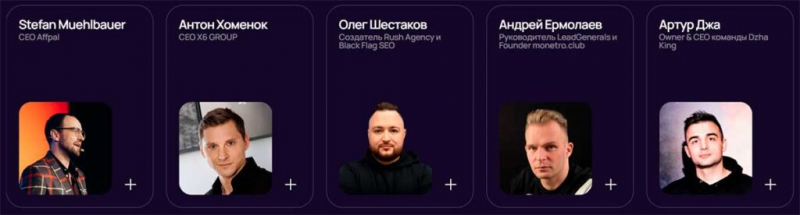
Stefan’s public biographies focus on affiliate management, training, workflow optimization, and data-driven decision-making, and his recent podcast already speaks the language of CAC/LTV/AOV and sustainable scaling.
Anton’s official website directly describes the stack of Telegram Ads, Facebook Ads, influence marketing and Telegram Mini Apps, and Philip Levine for eProfit sells not only access to the cabinet, but also moderation support, analytics and launch in 20+ GEO.
If we put all this into one thesis, then MAC-26 so far looks like a conference in the era of the institutionalization of the affiliate market. Here, HR, education, own media, huge datasets, moderation, the product layer and the performance approach are already visible at the first-line speaker level. This does not eliminate the classic traffic arbitrage, but it makes it just one part of a larger business machine.
Which trends should be read between the lines
The first big trend is the transfer of money to regulated GEO and “long” monetization models. In Brazil, fixed-odds betting and online gaming officially operate only through SPA authorization, and all federally authorized sites use a domain.bet.br.
At the same time, the market is huge: according to Reuters, Brazilians bet up to 30 billion reais per month after the launch of the regulatory regime. But the marginality story here is not linear: Better Collective expected a temporary hit to revenue due to taxes and the transition period, and then reported that the rebate was developing better than expected.
This is an important signal: in 2026, money is where the market is “legalized and maturing,” but it’s easier for system players with a turnover, compliance, and brand to earn there, rather than pure hunters for a fast CPA.
The second trend is dating has not died, but has become more mature and tougher on product quality.
Match Group had an almost flat revenue year in 2025, but in Q4 Hinge grew in direct revenue by 26% year-on-year, and MAU by European markets — by almost 50% over the year.
Bumble, on the other hand, saw revenue decrease by 9.9% in 2025, while paying users decreased by 11.5%. The conclusion from this is that there is still money in dating, but it is concentrated in products with better retention, trust, security and understandable segmentation. This means that Stefan’s presence in the first wave of macs is a signal that dating and high risk live where there is operational discipline and partner infrastructure.
The third trend is SEO remains monetary, but ceases to be “comfortable”. Better Collective directly links some of the problems of 2024 to Google’s policy changes on May 5, targeting third-party content in commercial categories.
Gambling.com In Q3 2025, the Group has already talked about the continuing problems in the field of organic search, spam, and the need to accelerate diversification; at the same time, it was revenue from repeat subscriptions from sports analytics services that grew the fastest.
For SEO specialists, this is almost a literalHint: “light” search in 2026 is less secure than a brand, its own audience, data, its own products, and a mixed model for attracting traffic.
The fourth trend is Telegram is exiting the experimental phase. The official Telegram Ads platform writes about 1 billion users, 1 trillion monthly views in public channels, contextual targeting without personal data, 50% channel coverage, and an ad format of up to 160 characters.
On top of this, eProfit already sells 20+ new geos in EUR cabinets, analytics, spy tools and moderation assistance, and promises CPM of €0.08 on the landing page for new GEOS.
At the same time, IAB/PwC report that digital ad revenue in the United States grew to almost $300 billion in 2025, and impact.com He writes that 59% of brands plan to give at least 25% of affiliate budgets, 97% of brands are already using AI, 94% are testing or planning alternative attribution.
Taken together, this is a very strong signal: affiliate marketing is looking less and less like an “offer table” and more and more at the intersection of the economics of content creators, distribution, paid traffic and accurate data.
What does this mean for SEO, webmasters, and arbitrators
Set the KPIs deeper than the lead and registration
The main conclusion here is that registration and clicks are increasingly becoming noise, not money. In his blog, MaxWeb quite directly promotes the idea that the metrics of real money are FTD, and not a cosmetic layer of registrations.
For webmasters and SEO specialists, this means even reassembling the content strategy: fewer texts for “winning keys in general”, more pages and funnels that filter the user by intent, solvency, trust signals and local context.
Add your own distribution
And X6, and eProfit, and the very logic of Telegram Ads show that own distribution level is insurance against platform risk. For SEO specialists, the practical version of this advice looks like this: article – Telegram channel/bot – CRM/retargeting – repeat contact.
This is especially important against the background of the fact that large public affiliate companies are already publicly suffering from the volatility of organic search and investing in diversification. If your entire business is based on one SERP inertia, then you are already working with a negative option.
Test GEO as a portfolio
Brazil shows that large regulated markets provide scale, but they put pressure on margins and require compliance.
Publications with Telegram Ads cases on the CIS, where Philip’s comment appears, show the opposite part of the equation: less overheated markets provide cheap tests, but require localization and very careful transfer of conclusions between GEO.
This means that in 2026 it is the one who manages the GEO portfolio who wins with different logic: scale control, underestimated expansion, and their own performance cycles.
If we reduce this to three actions that can be taken directly from the topic of future presentations, they will be as follows:
- Transfer analytics from top metrics to FTD/LTV/NGR.
- Embed your own audience layer, primarily through Telegram and CRM.
- To do GEO-expansion through localization and tests.
Conditional examples from practice
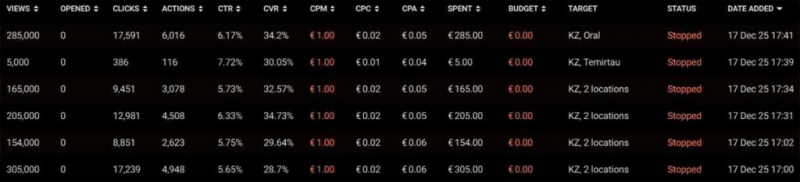
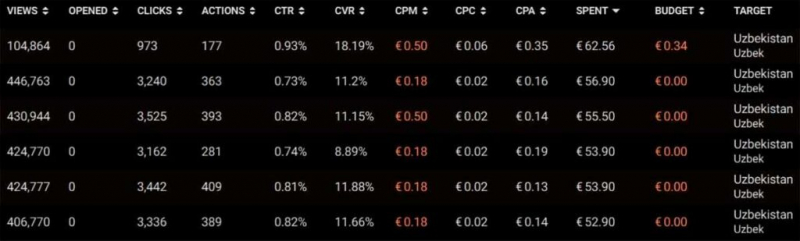
The most obvious numbers in this topic are now provided by the junction of Telegram Ads and the “which GEO are not overheated yet” approach.
In different cases in Kazakhstan, Uzbekistan and Belarus, very different economies are obtained. For example:
1. KZ, media niche
2. UZ, a niche investment
3. BY, the crypt niche

In Telegram, the cost of an audience differs not just by GEO, but by the combination of GEO + subject + intent + localization.
The same Telegram Ads can be either a cheap hypothesis test, or already quite expensive performance inventory. Therefore, any conversation about this channel without reference to GEO and the subject is superficial.
It is here that Philip’s master class in the context of MAC-26 looks like a rather interesting signal: Telegram is already big enough to require not general conversations, but applied competence.
The second useful thought is a simple FTD model for an SEO expert.
Let’s say an article or a cluster of pages gives you and me 10,000 clicks per month on an offer. Of these, 8% reach registration, and 20% of those who register make their first deposit. When paying $50 for FTD, this is 10 000 × 0,08 × 0,20 × 50 = $8 000 gross revenue.
If the traffic remains the same, but due to the content, landing page, trust block and localization, the FTD rate increases to 25%, then the revenue becomes $10,000. No magic: the same clicks, but +25% of the money only due to a deeper KPI…
In fact, this is exactly what MaxWeb promotes.
So I’m looking forward to the MAC!
P.S. I remind you that with the promo code “SEOASPIRANT” you can get a 10% discount on the GOLD and VIP categories!